The first TikTok Affiliate sale isn't a tactics problem. It's a belief problem.
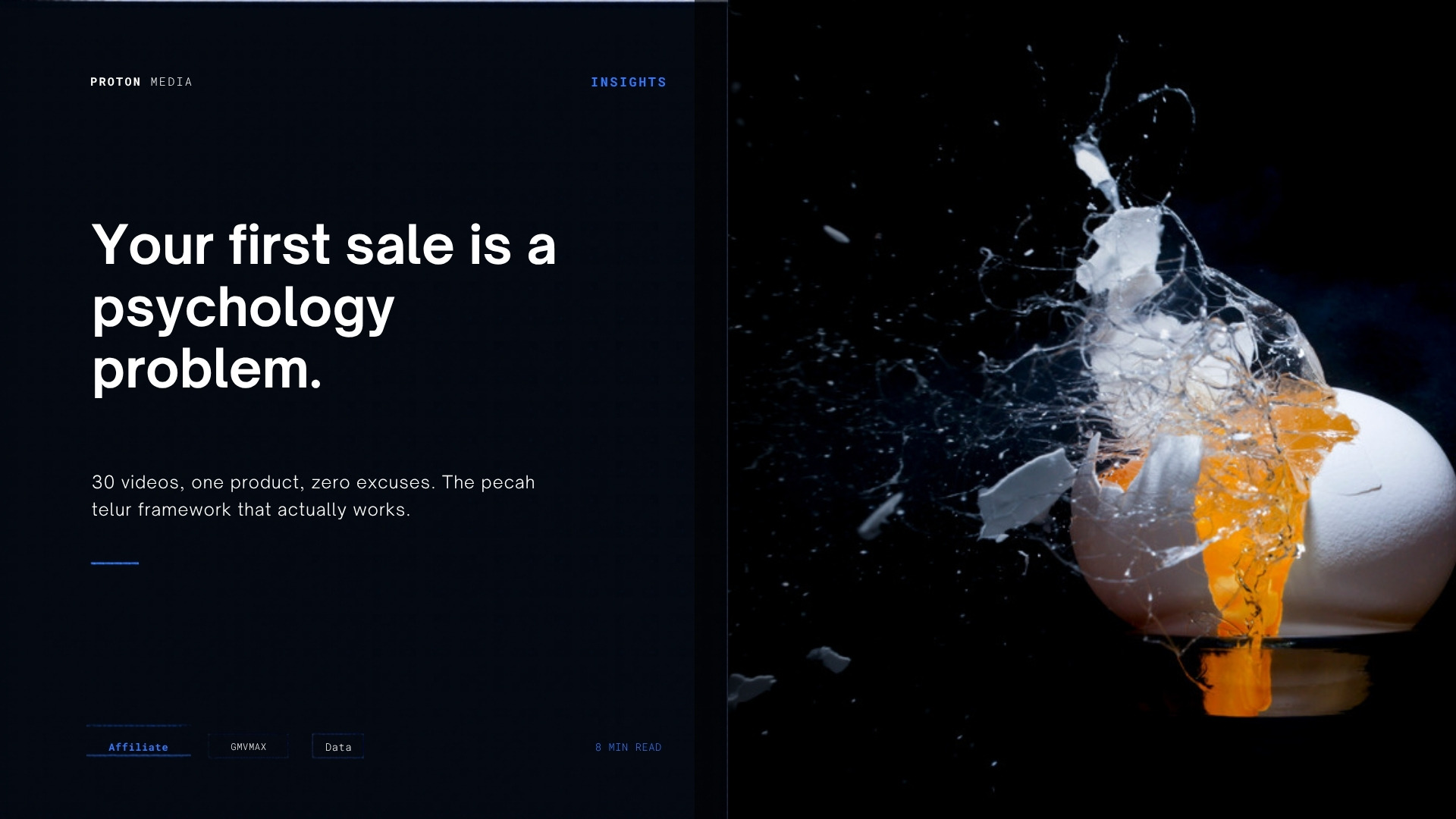
Many beginners quit before video 30. Not because the strategy failed — because they ran out of patience waiting for proof that the whole thing is real. That first sale isn't just a commission. It's evidence. Indonesian creators call it pecah telur — breaking the egg — and it carries psychological weight completely disproportionate to whatever small amount it actually pays.
Before pecah telur: every video feels like shouting into a void. After: posting rhythm locks in, product instincts sharpen, and consistency becomes easier because belief has a foothold.
The fix isn't the perfect product or the perfect hook. It's running enough experiments that a winning combination is statistically inevitable.
Why the First Sale Is Harder Than the Tenth
Affiliate creator @bertosb1m explained the structural difference in a 7-minute tutorial: the psychological barrier here is different from other sales models.
In network marketing or insurance, rejection is personal and visible. Someone looks you in the eye and says no. That compounds fast — the emotional cost per failed attempt is high enough that most people stop after a handful of rejections.
TikTok Affiliate rejection is invisible. Nobody says no to you — they scroll past. You never know which video almost converted, which hook was close, which product had potential but got killed by lighting. That invisibility is actually a feature: you can be ngotot (relentlessly persistent) without absorbing emotional damage every time. But it cuts the other way too. Without visible feedback, silence looks like failure, and most people quit before the data means anything.
The actual failure mode isn't making bad videos. It's making too few videos and drawing conclusions from a sample size that's statistically useless.
The 30-Video Minimum Rule
Here's the number that separates beginners from people who actually earn: 30 videos per product, minimum.
Not 5. Not 7. Not "a few to test the waters."
@bertosb1m is explicit: direct selling might survive 7 attempts before pivoting. Affiliate content is different — each video is an experiment with multiple independent variables. The hook. The CTA. The content format. The framing angle. Running fewer than 30 means you've barely begun to sample the variable space. You haven't completed one experiment yet.
Think of it as A/B testing at scale. 30 videos with varied hooks and CTAs gives you enough data points to spot patterns. Which hook generated saves? Which CTA drove link clicks? Which product angle earned watch-through? You cannot answer any of these questions with 7 videos.
The instinct to cut losses early — "this product isn't working" — is the exact instinct that kills first sales. You're not failing the product. You're refusing to complete the experiment.
Three Formats, Three Audience Relationships
Within those 30 videos, vary the format. @bertosb1m identifies three content structures, each targeting a different viewer relationship:
Face-On, Personal Branding
You're on camera, talking directly to the viewer. Highest perceived authenticity. Works well for products that benefit from testimony — when the creator's experience is the product's proof. Requires confidence, but that's exactly what beginners are building toward, not starting with.
Faceless Product Showcase
No face — just the product in use. Hands, context, the thing doing its thing. This removes the personal-branding barrier entirely, which makes it a legitimate starting point for creators who haven't built on-camera confidence yet. The product is the story; you're just the camera operator.
Product-First, Partial Face
A hybrid. Product leads the visual; creator is present but not the focal point. Often the safest starting format for beginners because it doesn't demand either full personal branding or full product cinematography skill. The product earns attention; the face provides trust.
The goal isn't to pick one format and commit to it permanently. The goal is to rotate all three across your 30 videos and let the algorithm tell you what works for this specific product with this specific audience. You're in discovery mode, not identity mode.
Building Your Hook and CTA Variable Library
The two highest-impact variables in any affiliate video are the hook (first 2-3 seconds) and the CTA (call to action). They're also the variables most beginners treat as fixed — they write one hook, one CTA, and wonder why everything performs the same.
Build a working library before your 30-video run begins. Vary both systematically across every batch of 5-10 videos. @bertosb1m gives concrete examples, and we add two frames of our own:
Hooks That Create Entry Points
- "Akhirnya datang juga!" — Arrival/reveal frame. Creates anticipation, implies this product was worth waiting for. Works well for products with visible packaging or unboxing potential.
- "Yang suka ribet kartunya, mendingan beli ini" — Problem-first frame. Calls out a specific pain point immediately, lets the viewer self-identify. Strong for products solving an actual inconvenience.
- Urgency frames (our addition): implies scarcity or timing without fabricating stock numbers.
- Curiosity frames (our addition): drops an unexpected outcome in the first sentence — "I stopped buying [category] after I tried this."
CTAs That Move Action
- "Cek link di kiri bawah" — Direct, friction-minimal. Works for audiences already warm on the product after watching through.
- "Promo hari ini aja, gue khawatir besok udah nggak" — Urgency-based, taps loss aversion. Use this when there's a real discount or limited offer window — not as a hollow threat. Viewers can smell manufactured urgency.
- Soft CTAs: "Penasaran harganya berapa? Coba cek link." — lower commitment ask, better for cold audiences who engaged with the content but haven't warmed to the product yet.
When one hook-CTA pair consistently outperforms the others, that's signal. Double down on that combination in your next batch while continuing to explore new combinations with the others.
The One Product Selection Filter That Actually Matters
Before posting a single video, check one thing: is the seller already running ads?
Open TikTok and search for content featuring the product. If you see videos labeled "Ad," the seller is actively spending on paid distribution. That single observation tells you three things:
- The seller has confidence in the product's conversion rate. They wouldn't burn ad budget on something that doesn't convert at checkout.
- Your organic content benefits from the seller's demand creation. Paid ads build awareness you can capture for free. You're swimming with the current, not against it.
- There's a GMVMAX amplification pathway. TikTok Shop's automated ad system, GMVMAX, lets sellers automatically amplify performing affiliate content. If your video performs and the seller is already in that ecosystem, your best content has a real path to paid distribution without you doing anything.
Avoid products where the seller does zero marketing. You'd be doing all the awareness work for a seller who isn't invested in their own product distribution. The product might be fine — the economics aren't.
The Visual Quality Floor
This isn't about professional gear. It's about clearing one specific standard: the product must be clearly visible and well-lit.
@bertosb1m's guidance is practical: an old phone is fine, but use the back camera (higher resolution than front), shoot in natural light, and make sure the product is in sharp focus during the moments that matter. Poor visual quality functions as a trust signal — viewers read it as low product quality, even when that's completely wrong.
Three checks before posting:
- Product is in sharp focus in at least three shots
- No heavy backlight (window should face you, not be behind the product)
- Audio is clear enough to follow without concentration, or captions are present
Below this floor, hook quality and CTA variation don't matter. Fix the visual baseline first.
From 30 Videos to the Boost Pathway
Your first 30 videos are pure discovery. When you've posted them, the experiment phase ends and the reading phase begins.
Look for outliers: videos that pulled significantly more views than your average. If one video hit 5,000 views on an account that typically lands at 400, that video found a distribution wedge. The hook, format, or framing angle resonated in a way the algorithm noticed and rewarded.
That's the video you promote. @bertosb1m's next step is to put paid promotion behind it, which he describes as a way to bait the seller's GMVMAX. If it converts, sellers running GMVMAX campaigns can pick up your content and push it further using their automated bidding. You identified the winner through organic experimentation; GMVMAX scales what's already validated.
Seen that way, the 30-video minimum rule reads differently. You're not just trying to get lucky. You're building a pool of content that seller amplification can draw from.
The flywheel: organic variation surfaces a winner → you boost it → seller's GMVMAX amplifies it → commission follows. You never try to predict the winner in advance. You let the 30-video experiment surface it, then amplify what the data shows you.
Beginner vs. Scaling: Two Different Games
The volume strategy covered in The Brutal Math Behind TikTok Affiliate is built for creators who already earn and are compounding through multi-brand GMVMAX. That's a different problem from the one here.
| Dimension | Pecah Telur (Beginner) | Brutal Content Scaling |
|---|---|---|
| Target audience | Complete beginners, zero sales | Creators already earning |
| Primary goal | First sale + build belief | Scale via multi-brand GMVMAX |
| Video count | 30 per product, one product | 20-50/day, multiple products |
| Product strategy | One product, full commitment | Diversify sellers, reduce dependence |
| Core mechanism | Variation + volume = discovery | GMVMAX passivity + content pipeline |
| Psychological challenge | Persist without visible feedback | Systems thinking, not hustle |
Don't skip to the scaling playbook before you've completed the beginner one. The mindset is different. The mechanics are different. More importantly: you need a real data foundation before you can identify what's worth scaling.
The Sequence, Without the Motivation
Summarized as decisions, not inspiration:
- Choose one product where the seller runs paid ads. Not five products. One.
- Build your variable library before you start: 8-10 hooks, 5-6 CTAs, all three format types mapped out.
- Set your visual floor: back camera, natural light facing you, product in focus. Don't post below this.
- Post 30 videos, systematically rotating hooks, CTAs, and formats. No early evaluation. The experiment isn't done at video 12.
- Read the data after 30. Identify the top 2-3 performers by view count and engagement depth.
- Boost the winner with paid promotion to put it in front of the seller's GMVMAX.
- Keep going until the first sale lands. Nobody can tell you which video it will be, which is why the 30-video floor matters. When it happens — don't stop. The egg broke; now build the pipeline.
One More Thing About Persistence
The word @bertosb1m uses — ngotot — doesn't translate cleanly into English. It's persistence, but with a stubborn, almost unreasonable quality. The kind that keeps going after most people have decided it's not working.
That quality is specifically adaptive for TikTok Affiliate in a way it isn't for most sales contexts. The cost of each failed attempt is near-zero. No rejection, no awkward follow-up, no damaged relationship. A video that gets 11 views cost you 20-30 minutes and nothing else.
The math is in your favor if you stay long enough to complete the experiment. 30 videos at 25 minutes each is 12.5 hours of total work. Many beginners quit before they've accumulated a single full day's equivalent of effort.
The creators who pecah telur aren't more talented. They completed the experiment.