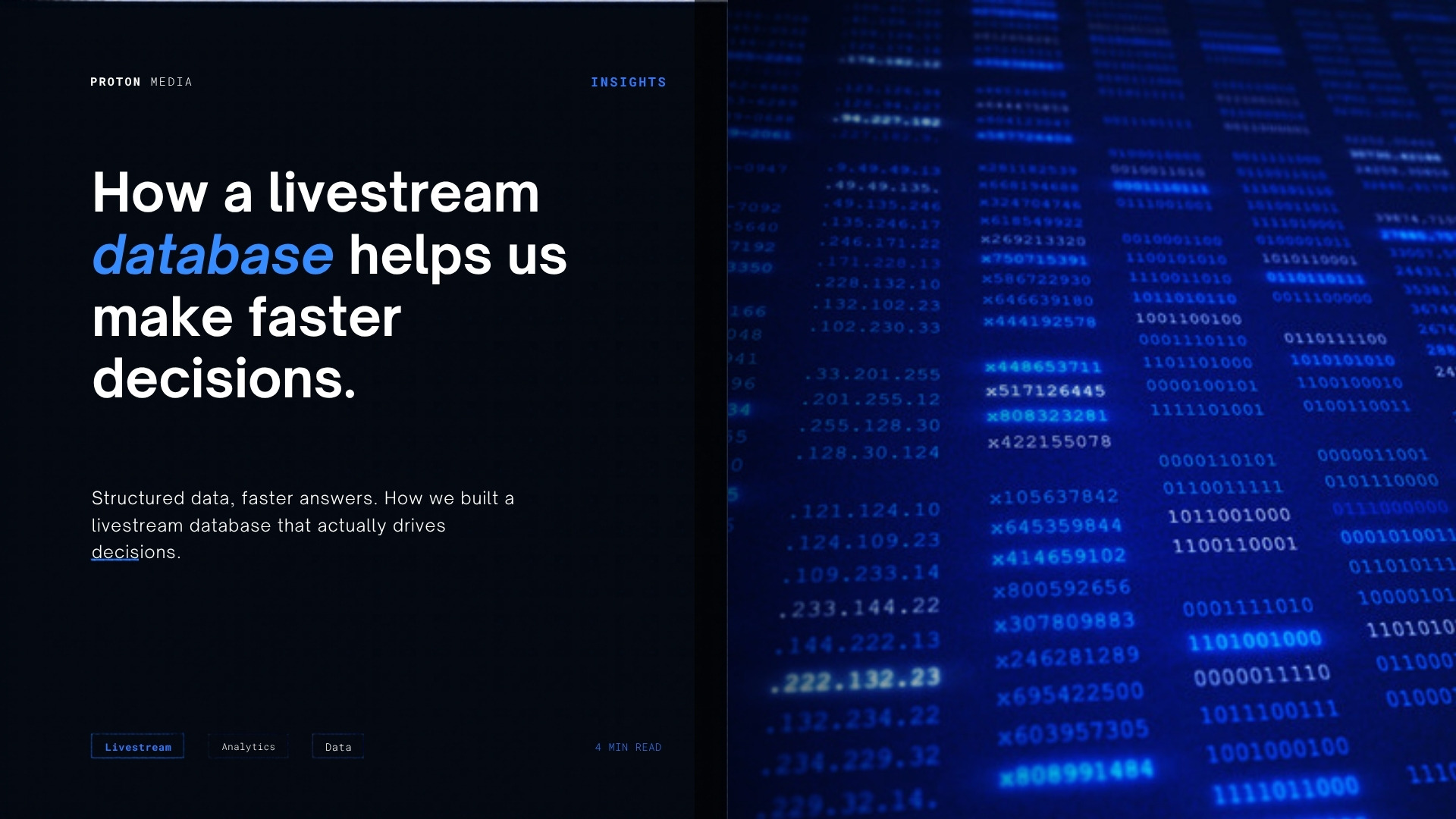
The hardest part of managing TikTok livestream operations across multiple brands isn’t the content, the hosts, or the scheduling. It’s answering simple questions fast enough to act on them.
Questions like: Which product drove GMV yesterday? Which SKU has strong add-to-cart but weak conversion? Which brand needs attention this week?
In a spreadsheet, each answer takes minutes of filtering, scrolling, and cross-referencing tabs. In a database, it takes seconds. That difference sounds small. It changes everything.
The Before State
We run livestream operations for two beauty brands — one mass-market, one clinical skincare. Between them, that’s many hours of live content every week.
Before we built the database, our daily review looked like this:
- Open the Google Sheet for Brand A
- Navigate to the correct date tab
- Filter by session, scan hourly numbers
- Manually sum the GMV column
- Repeat for Brand B
- Copy numbers into a summary slide
- Realize you forgot to check product performance
- Open another tab, re-filter, start over
Total time: far too long for a basic daily check. And this was just checking — not analyzing. Any deeper question required starting the process over with different filters.
The After State
Now we query the database directly. Here’s the kind of view it gives across both brands for an eleven-day window (an illustrative example, not client data):
Brand A (Mass-Market Beauty):
- GMV: Rp250.9M
- Views: 133.3K
- Orders: 2,588
- Live Hours: 228
Brand B (Clinical Skincare):
- GMV: Rp62.5M
- Views: 36.5K
- Orders: 817
- Live Hours: 236
Combined:
- GMV: Rp313.4M
- Views: 169.8K
- Orders: 3,405
Numbers like these used to take a manual compile every morning. Now they’re available the moment the daily sync runs. But the real value isn’t the speed of retrieval — it’s the questions you start asking once retrieval is instant.
Better Questions, Not Just Faster Answers
When pulling a single number takes minutes, you only pull the numbers you absolutely need. Your analysis stays surface-level by default — not because you lack skill, but because each question has a time cost.
When pulling a number takes seconds, you start asking follow-up questions that would have been “not worth the time” before:
“Which product drove GMV?” becomes “Which product drove GMV, and has its conversion rate changed compared to last week?”
“Which day underperformed?” becomes “Which day underperformed, and was it a traffic problem or a conversion problem?”
“Which brand needs attention?” becomes “Which brand’s GMV-per-viewer is declining, and which specific product category is driving that decline?”
These compound questions are where business insight actually lives. A database doesn’t make you smarter. It removes the friction that prevents you from thinking deeply.
The Diagnosis Speed Advantage
In livestream commerce, timing matters more than in most marketing channels. A livestream session happens in real-time. If a product isn’t converting, you need to know during the session or immediately after — not three days later when someone finishes the weekly report.
Our database lets us diagnose performance gaps within hours of a session ending:
- High views, low orders? Traffic quality issue. Check the audience source.
- High add-to-cart, low checkout? Pricing or shipping friction. Review the product page.
- Low views, high conversion? The content is good but distribution is weak. Adjust the scheduling or promotion.
Each of these diagnoses used to require opening multiple spreadsheet tabs and manually comparing columns. Now it’s a filtered query that returns results instantly.
The operational advantage isn’t theoretical. When you can diagnose a problem on Tuesday morning instead of Friday afternoon, you can fix it for Wednesday’s session instead of next week’s.
What This Means for Scaling
Here’s the business case in one sentence: a database lets you add brands without adding headcount.
Our pipeline handles two brands today. Adding a third brand means adding three more tables to the database and three more JSON exports to the dashboard. The sync script, the dashboard, and the analysis layer don’t change. The marginal cost of a new brand is close to zero.
Compare that to the spreadsheet approach, where each new brand means a new workbook, new tabs, new formulas, and another block of daily manual review.
If you’re planning to scale your livestream operations — more brands, more sessions, more products — the question isn’t whether you need a database. It’s how many brands you’ll try to manage in spreadsheets before you build one.
The Uncomfortable Truth
Most livestream teams know their spreadsheets are too slow. They keep using them because building something better feels like a project — and there’s always a more urgent livestream to plan, a more pressing report to deliver.
But the cost of slow data isn’t visible on any dashboard. It shows up in the questions you never asked, the patterns you never spotted, the problems you diagnosed three days too late.
The best dashboard isn’t the prettiest one. It’s the one that lets you answer business questions in seconds. Everything else is decoration.