Every social media manager alive right now is having the same conversation: should we use AI for content?
The answer stopped being interesting about six months ago. Of course you should. In HubSpot's 2025 State of AI report, 55% of marketers named content creation as the most popular use of AI in content marketing. The real question — the one that separates teams that scale well from teams hemorrhaging followers — is how.
Because here's the uncomfortable truth most AI content guides won't tell you: audiences can tell. And when they can tell, they scroll past.
The output multiplier is real
Let's start with what AI actually delivers: speed. Drafts, caption variants and first-pass repurposing that used to eat a morning can be ready in minutes, which means faster iteration cycles.
These gains aren't aspirational. They're what happens when you hand caption writing, hashtag research, content repurposing, and first-draft generation to a model that doesn't need coffee breaks.
The trap is thinking output equals outcome. It doesn't.
The uncanny valley of branded content
A growing share of branded social content is now AI-generated or AI-assisted. And audiences have started developing antibodies.
You've seen the symptoms: posts that read like they were optimized for an algorithm rather than written for a human. Captions that use "leverage" and "in today's landscape" and "here's the thing" in the same paragraph. Perfectly structured, perfectly lifeless.
The problem usually isn't that AI can't write well — it can — it's that too many teams aren't editing the output. They're publishing first drafts.
That's the uncanny valley problem. The content is technically correct but emotionally empty. And social media is an emotional medium.
The hybrid model that actually works
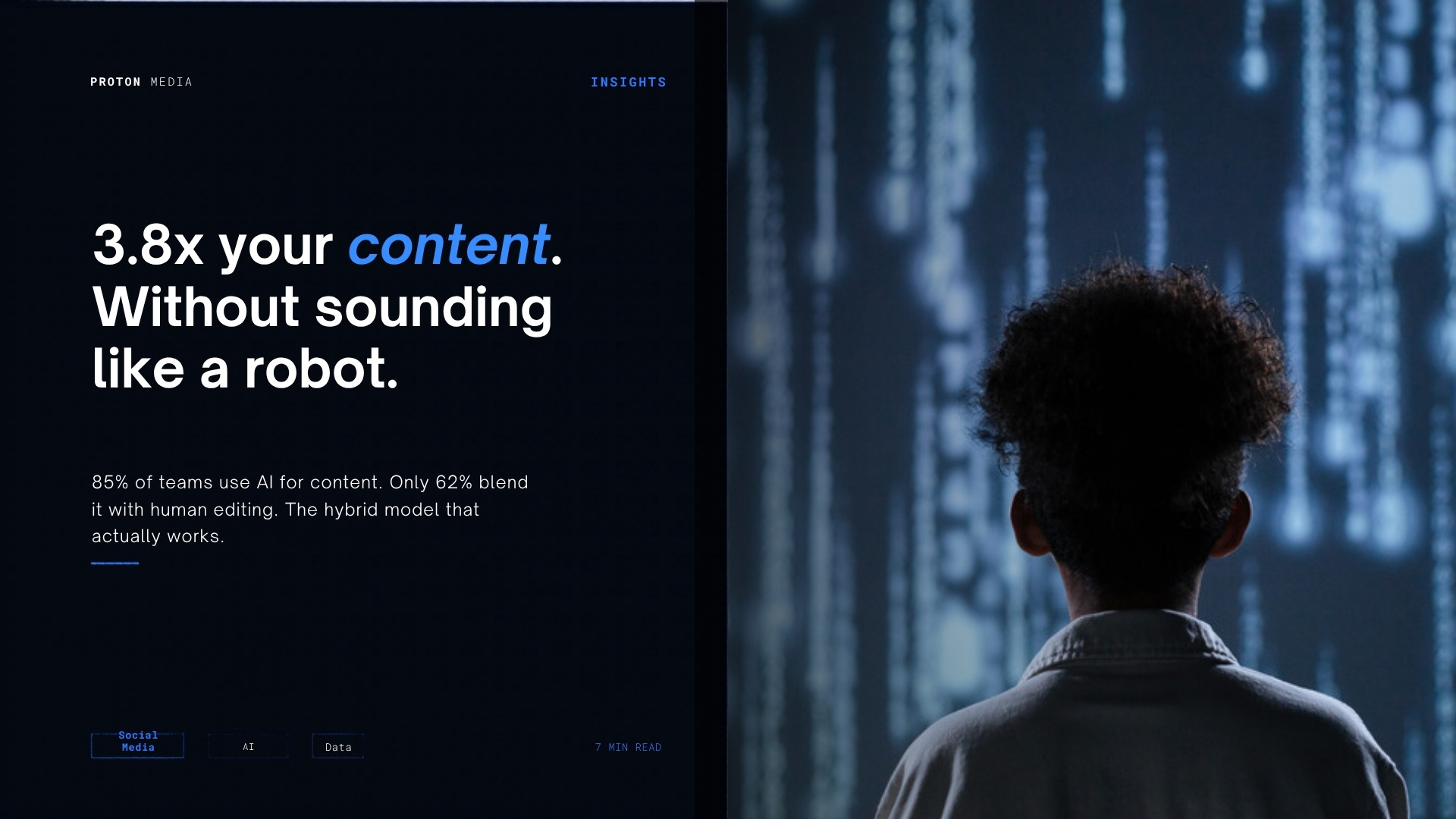
The model that holds up is a hybrid one: AI generates the raw material, humans shape the final product.
The model works because it uses each side for what it's best at. AI is exceptional at speed, pattern recognition, variant generation, and data synthesis. Humans are exceptional at nuance, timing, cultural context, and — critically — knowing when a joke lands versus when it falls flat.
At Proton Media, our social content pipeline runs hybrid by default. AI produces first drafts, suggested hooks, and hashtag clusters. A human editor adds voice, trims the corporate-speak, and decides whether the tone matches the client's brand on that specific day. The edit pass is short. The quality difference is night and day.
5 humanizer tactics that actually move the needle
The difference between AI-assisted content that performs and AI-assisted content that flops usually comes down to five editing habits:
1. Inject first-person specificity. AI defaults to third-person generalizations. "Brands should consider..." becomes "We tested this on three accounts last week and..." Specificity signals lived experience. Audiences trust experience over advice.
2. Break one grammar rule per post. AI writes clean. Too clean. A sentence fragment here, a casual "tbh" there — these imperfections signal a human behind the keyboard. Don't overdo it. One deliberate break per post is enough.
3. Add the opinion AI won't give you. AI hedges. It says "some experts believe" and "there are arguments on both sides." Your audience doesn't follow you for balanced analysis. They follow you for a point of view. Take a stance. The post that says "this strategy is dead and here's why" will always outperform "5 strategies to consider."
4. Reference time and place. "This morning" beats "recently." "On our Jakarta shoot last Tuesday" beats "in our experience." Temporal and geographic anchors are hard for AI to fabricate convincingly, which is exactly why they read as authentic.
5. Cut the setup, keep the punch. AI loves a three-sentence introduction before the actual insight. Delete it. Start with the insight. Social media rewards density — the hook should be the value, not the preamble.
AI leverage points most teams are ignoring
The content creation angle gets all the attention, but the biggest AI wins in social media aren't in writing captions. They're in the infrastructure around content:
Content repurposing at scale. One longform video becomes 12 assets: clips, quote cards, carousel frames, newsletter excerpts. AI handles the decomposition; humans pick which angles match each platform's culture. This is where most of the output gain actually lives.
Predictive scheduling. Tools like Sprinklr and Later now use engagement pattern analysis to recommend posting windows per audience segment — not just "best time to post" averages, but personalized timing based on your specific follower behavior. It costs zero creative effort.
Performance pattern recognition. AI can scan 90 days of post performance and surface patterns you'd miss by hand. For example (an illustration, not client data), it might show that your data-visualization carousels earn far more saves than your text carousels — the kind of signal that's easy to miss across hundreds of posts.
The governance gap nobody talks about
Here's what should concern every marketing leader: many teams using AI for social content still have no formal AI content policy. They're doing it without guardrails.
No policy on disclosure. No quality benchmarks. No brand voice calibration process. No review chain that distinguishes "AI-drafted, human-edited" from "AI-generated, auto-published."
This matters because the regulatory environment is shifting fast. The EU AI Act's transparency rules (Article 50), which include labelling duties for certain AI-generated content, apply from 2 August 2026. Platform policies are evolving quarterly. Teams without governance are building on a foundation they might need to rebuild.
A practical AI content policy doesn't need to be a 30-page document. It needs four things: a disclosure standard, a minimum edit threshold, a brand voice checklist, and a named human accountable for every published post. That's it. Build it in an afternoon. Enforce it starting tomorrow.
The bottom line
AI will make your social media team faster. That's not a prediction — it's already happening across marketing organizations. The question is whether speed creates value or just volume.
The teams winning right now aren't the ones publishing the most AI content. They're the ones publishing AI-assisted content that reads like a sharp human wrote it — because a sharp human finished it. The hybrid model. The human edit pass. The opinion that AI won't generate on its own.
More output means nothing if engagement drops. But more output with a humanizer layer? That's the multiplier that actually compounds.