The Retrieval Revolution No One Announced
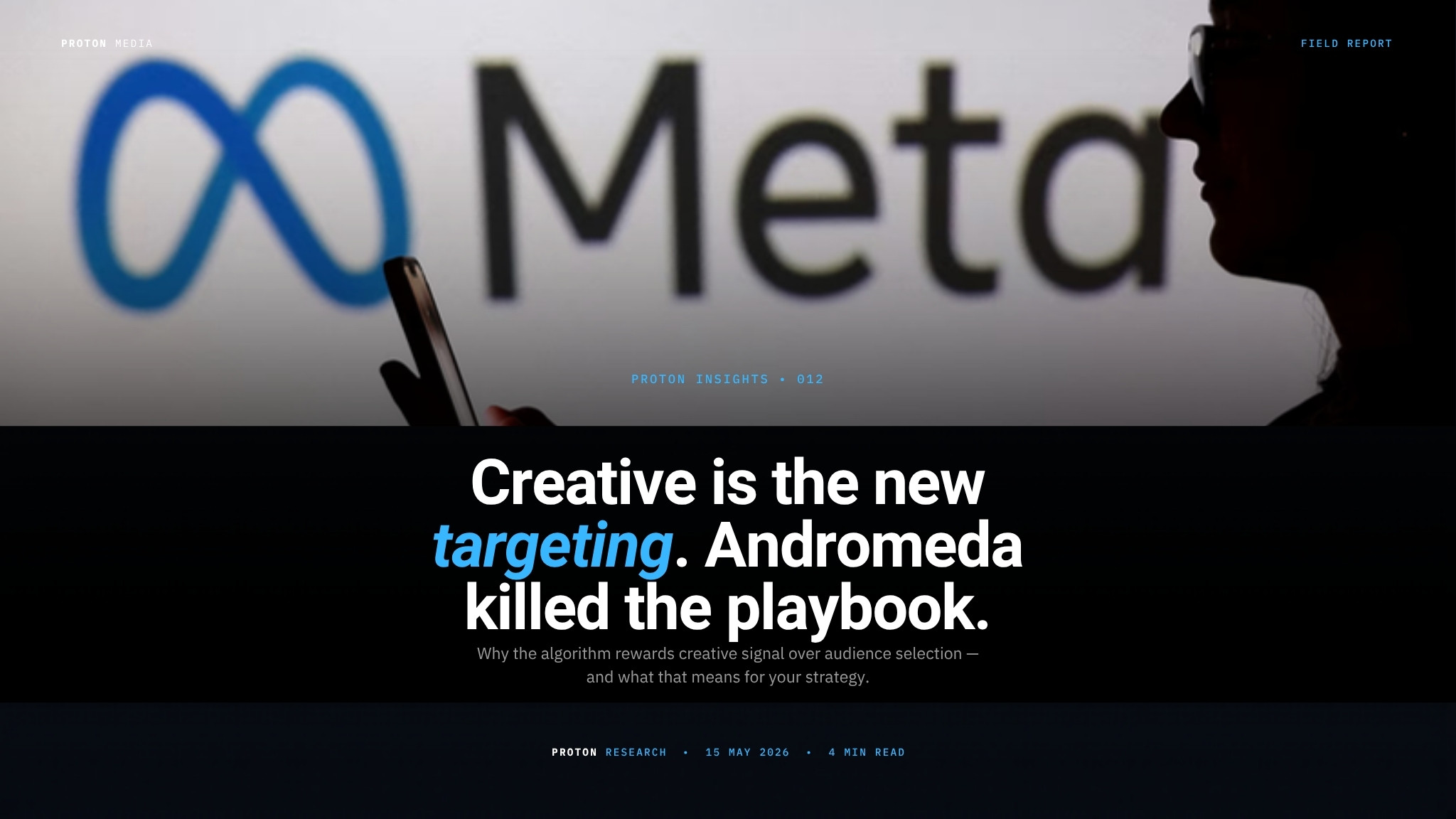
In October 2025, Meta quietly replaced the entire ad retrieval pipeline powering Facebook and Instagram. The new system — internally called Andromeda — represents a 10,000x increase in model complexity over the previous architecture.
That number isn’t marketing fluff. It comes directly from Meta’s engineering blog, published December 2024, detailing how retrieval now evaluates billions of candidate ads in real time using dense neural embeddings instead of the sparse, rules-based system that powered the platform for over a decade.
Here’s what that means in practice: retrieval is the gatekeeper. Before your bid gets evaluated, before your budget matters, before your targeting parameters are even considered — Andromeda decides whether your ad is worth showing at all. And it makes that decision based primarily on one thing: your creative.
Retrieval is no longer a filter. It’s a judge. If your creative doesn’t pass Andromeda’s relevance threshold, your campaign never enters the auction — no matter how much you’re willing to pay.
The Data That Proves Targeting Is Dead
This isn’t theory. The numbers are unambiguous.
Confect analyzed 3,014 advertisers across $834 million in spend and 115.7 billion impressions. Their finding: accounts still running legacy audience structures — stacked lookalikes, layered interest targeting — showed measurable ROAS decline compared to those who had consolidated into broad, creative-diversified campaigns.
JetFuel Agency confirmed this from the practitioner side: broad targeting with differentiated creative consistently outperforms 1% lookalike audiences. The pattern held across verticals — ecommerce, lead gen, app install.
The market has already voted. 78% of Meta ad spend now runs through Advantage+ campaigns — algorithm-first, not audience-first. The remaining 22% isn’t a strategic choice. It’s inertia.
| Metric | Source | Finding |
|---|---|---|
| 10,000x complexity increase | Meta Engineering | Andromeda vs. legacy retrieval |
| 56% of performance | Meta Internal | Driven by creative quality alone |
| 78% of spend | Digital Applied Q1 2026 | Running on Advantage+ |
| 65% higher ROAS | Scaledon | Brands testing 20+ ads/month vs. <10 |
| 4x efficiency gain | Meta | Over previous ranking models |
How Andromeda Actually Reads Your Creative
Understanding retrieval changes how you think about creative production.
Andromeda uses computer vision and semantic analysis to understand what’s in your ad — the product, the visual style, the mood, even the text overlays. It builds a dense vector representation of each creative and matches it against user-level embeddings built from behavior signals.
The critical detail: Andromeda clusters similar ads into a single Entity ID. Ten variations of the same product shot on a white background? That’s one retrieval ticket, not ten. You’re not diversifying — you’re duplicating.
This is why the old playbook of “make five versions with different headlines on the same image” stopped working. Andromeda sees through surface variation. It wants genuinely different angles, different visual compositions, different product contexts.
Stop thinking about ad variations. Start thinking about ad angles. Each creative should represent a distinct buyer motivation, not a cosmetic difference.
The Practitioner’s Pivot
Here’s the tactical shift, compressed to what actually matters:
Kill the multi-ad-set structure. Five ad sets targeting five different lookalike audiences with five creatives each? Replace it with one to two broad ad sets loaded with 20-25 diverse creatives.
This isn’t a theory. Logical Position tested it in February 2026: one ad set with 25 diverse creatives outperformed five ad sets with five creatives each by 17% on conversions and 16% on cost efficiency.
Build for angles, not audiences. Instead of segmenting by demographic or interest, segment by buyer motivation:
- The skeptic — needs proof, data, social validation
- The impulse buyer — needs urgency, scarcity, visual appeal
- The researcher — needs comparison, features, long-form context
- The brand loyalist — needs new product news, exclusivity
Each motivation gets its own creative treatment. Andromeda does the matching. You do the creative thinking.
Volume matters, but diversity matters more. Brands testing 20+ creatives per month see 65% higher ROAS than those testing fewer than 10. But only if those 20 creatives represent genuinely different approaches — not 20 color swaps.
What This Means for Performance Teams
The skill set that wins on Meta in 2026 is not media buying. It’s creative strategy.
The person who can brief a shoot, identify an untested angle, write a hook that stops thumbs, and iterate based on Entity ID-level performance data — that person is now more valuable than the person who can build a nested lookalike structure in Ads Manager.
Budget rebalancing follows. Teams spending 70% on audience research and testing, 30% on creative production need to flip that ratio. The algorithm handles distribution. Your job is to give it ammunition.
The old question was: “Who should see this ad?” The new question is: “What should this ad say — and to which motivation?” Andromeda answers the first question better than you can. Focus on the second.
56% of campaign performance is now driven by creative quality alone, according to Meta’s internal data. That number will only grow as Andromeda continues to improve. The audience-first playbook isn’t just suboptimal — it’s actively working against the system that decides who sees your ads.
Creative is the new targeting. Act accordingly.