The Way Most Agencies Find Creators Is Embarrassingly Manual
Here’s how KOL recruitment works at most agencies in Indonesia. A brief comes in from a client. Someone opens TikTok and starts scrolling. They search a few hashtags, screenshot some profiles, drop them into a Google Doc. Maybe they check follower counts. Maybe they don’t. They send the list to the client, the client picks a few names based on vibes, and the outreach begins — one DM at a time, one WhatsApp message at a time, one follow-up at a time.
The whole process takes one to two weeks. For a list of maybe 20-30 creators.
By the time the outreach is done, half of them have already committed to a competitor’s campaign. The ones who respond need negotiation. The ones who agree need briefing. And by the time content goes live, the campaign window has shrunk by a month.
We decided early on that this process was broken. Not just slow — fundamentally broken. If your creator recruitment depends on someone’s ability to scroll and remember, you’ve built your pipeline on the weakest possible foundation.
So we rebuilt it from scratch.
The Database That Changed Everything
The core of our system is a creator database that we’ve been building and refining since we started managing KOL campaigns at scale. Every creator we’ve ever worked with, evaluated, or researched goes into this database. Not just the big names — every nano, micro, mid-tier, and macro creator across the categories we operate in.
Each creator profile stores more than just follower count and engagement rate. We track:
- Content format patterns. Does this creator do tutorials, reviews, day-in-my-life, or talking head? What format do they default to for sponsored content?
- Category affinity. A beauty creator who also does food content is different from a beauty-only creator. We map the overlap.
- Historical campaign performance. If we’ve worked with them before — or if we have data from affiliate dashboards — we store conversion metrics, not just vanity metrics.
- Response behavior. How fast do they reply? Do they negotiate heavily? Do they deliver on time? These operational details matter more than most agencies admit.
- Audience composition. Geography, age range, gender split — pulled from creator media kits or platform analytics where available.
The database isn’t static. It grows every week as our team evaluates new creators and updates records from active campaigns. At this point, it’s one of the most comprehensive creator datasets in the Indonesian market for the categories we cover.
The power of a structured database isn’t just recall — it’s pattern recognition. When a client says “I need skincare creators in the Rp 3-5M budget range who’ve done TikTok Shop affiliate before and actually convert,” we don’t start searching. We query. The difference in speed is measured in days saved.
Where AI Comes In
A database is only as useful as your ability to find the right person in it at the right time. When you have thousands of creator profiles across multiple categories, manual filtering breaks down fast. You end up relying on whoever the account manager remembers, which means the same 30 creators get recommended to every client.
We implemented AI into our workflow to solve three specific problems:
1. Intelligent matching. When a campaign brief comes in, we feed the requirements — category, budget range, content format, platform, audience geography — and the system surfaces ranked recommendations from our database. Not random suggestions. Ranked by predicted fit based on historical data patterns.
2. Data enrichment. Creator profiles go stale fast. Someone who had 50K followers six months ago might have 200K now — or might have stopped posting entirely. AI helps us flag profiles that need updating and pull in fresh metrics so our recommendations are based on current performance, not outdated snapshots.
3. Similarity discovery. This is the one that changed our game the most. When a client says “we want someone like Creator X but in a lower budget tier,” the system finds creators with similar content styles, audience profiles, and engagement patterns — even if our team has never manually connected those dots. It expands the pool beyond human memory and bias.
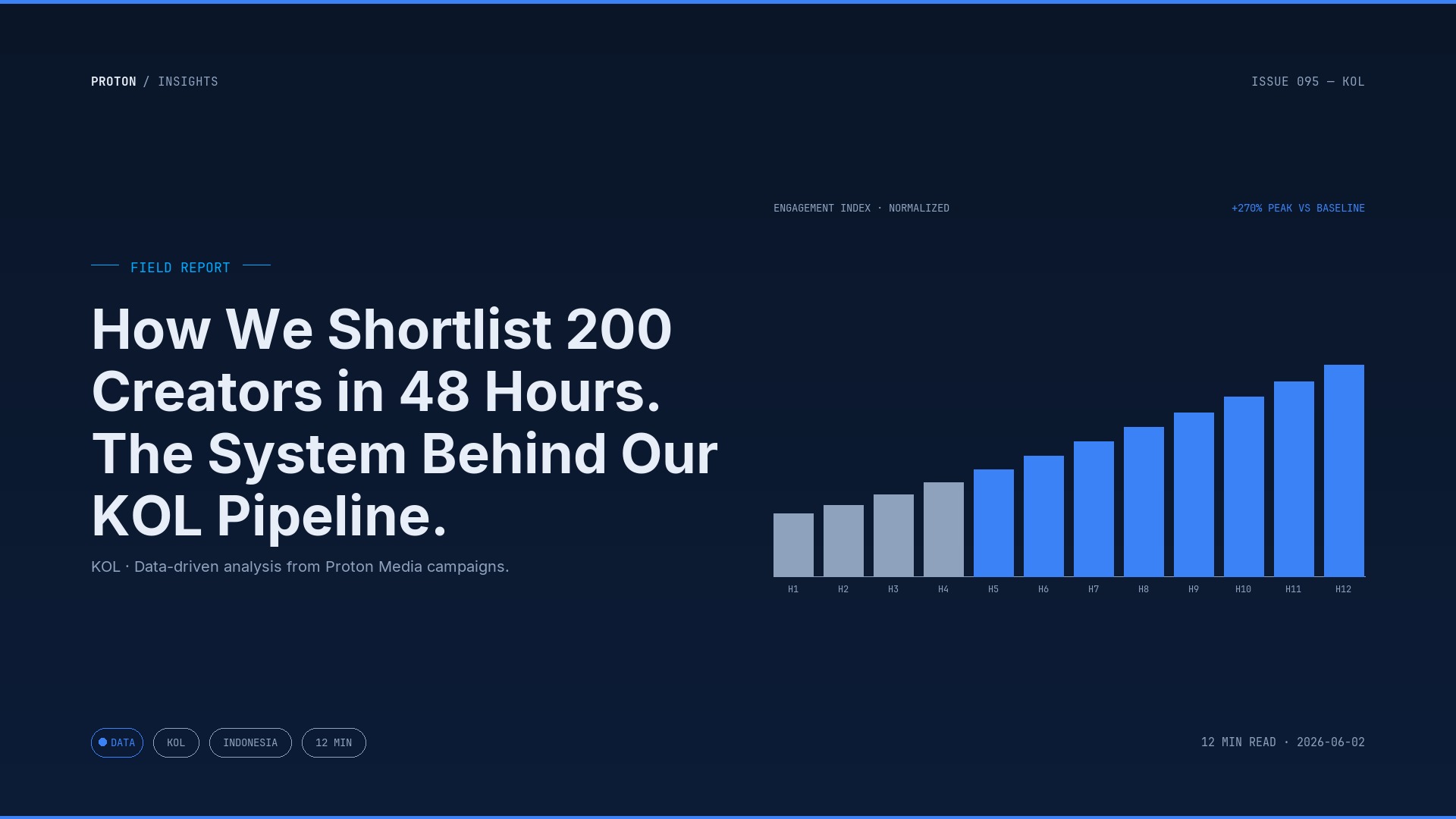
The result: our shortlisting process that used to take days now takes hours. Not because we cut corners — because the system does the heavy lifting of searching, filtering, and ranking, and our team focuses on the judgment calls that actually require human expertise.
The Template Engine: Research to Outreach in One Flow
Finding the right creators is half the problem. The other half is reaching them efficiently without losing quality or personalization.
Most agencies treat outreach as a creative writing exercise. Every message is drafted from scratch. Every negotiation follows a different format. Every contract has slightly different terms because whoever wrote it last time isn’t the same person writing it this time.
We templatized the entire pipeline — not to make it robotic, but to make it consistent and fast.
Research template. When evaluating a creator for a campaign, our team fills a structured assessment. Same fields, same criteria, every time. This eliminates the “I just had a good feeling about this one” problem and creates evaluations that are comparable across creators.
Outreach templates. We’ve built message templates for every stage — initial contact, rate negotiation, brief delivery, timeline confirmation, follow-up sequences. Each template has variable fields that get personalized (creator name, specific content reference, campaign details), but the structure and key information are consistent.
The automation layer. Here’s where the spreadsheet engineering comes in. Our outreach workflows are built in structured spreadsheets that connect creator data, campaign requirements, and communication templates. When a campaign is approved:
- Creator shortlists populate automatically from the database query
- Outreach messages generate with personalized fields pre-filled
- Follow-up schedules set themselves based on response status
- Status tracking updates as creators respond, accept, or decline
The account manager’s job shifts from “write 50 individual messages and track responses in your head” to “review the generated outreach, personalize where needed, and manage the conversations.” The system handles the repetitive mechanics. The human handles the relationship.
The biggest efficiency gain isn’t in the automation itself — it’s in the error reduction. When you’re manually managing 50+ creator outreach threads, things get missed. Follow-ups fall through cracks. Rate negotiations get confused between creators. Templates and automation don’t just make the process faster — they make it reliable.
What This Looks Like in Practice
A real campaign scenario — without naming the client:
Day 1. Brief received: skincare category, 30 creators needed across nano and micro tiers, TikTok focus, budget allocated per tier, campaign window in 3 weeks.
Day 1 (same day). Database queried. AI surfaces 85 ranked creator recommendations matching category, tier, platform, and budget criteria. Team reviews and shortlists 45 top candidates based on content quality and brand fit.
Day 2. Outreach messages generated from templates with personalized elements. All 45 creators contacted via their preferred channels (DM, WhatsApp, or email depending on what’s stored in their profile).
Day 3-4. Responses tracked automatically. 28 creators respond positively. Rate negotiations handled through standardized templates. 6 decline or don’t respond — replacement candidates pulled from the ranked list instantly.
Day 5. Final roster of 30 creators confirmed. Briefs sent using the one-page template format. Campaign timeline locked.
Five days from brief to confirmed roster. Not two weeks. Not one week. Five days — with a larger, better-qualified creator list than most manual processes produce in twice the time.
Speed Without Sacrifice
The concern we hear most from prospective clients when we explain our system: “If it’s that fast, are you cutting corners on quality?”
The opposite is true. Speed is a byproduct of structure, not a replacement for judgment.
Every creator on our shortlist still gets evaluated by a human who understands the brand. Every outreach message still gets reviewed before sending. Every campaign brief still gets tailored to the specific product and objectives. The AI and automation handle the parts that don’t require human judgment — searching, filtering, ranking, formatting, scheduling. The parts that do require judgment — brand fit assessment, creative quality evaluation, relationship management — stay with our team.
The brands that work with us don’t get a faster version of a mediocre process. They get a better process that happens to also be faster.
That’s the difference between automation that replaces thinking and automation that removes busywork so your team can think more.
Why This Matters for Your Next Campaign
If you’re evaluating agencies for KOL, influencer, or affiliate campaigns, ask one question: “Show me your creator database and your outreach workflow.”
If the answer involves someone opening TikTok and scrolling, you know what you’re getting — manual effort that scales linearly with campaign size. Double the creators means double the time and double the chances of something falling through the cracks.
If the answer involves a structured system with data, AI matching, and templated workflows, you’re looking at an operation that scales without proportionally increasing cost or decreasing quality.
We built this system because we got tired of watching good campaigns fail due to slow recruitment. The strategy was right, the budget was there, but by the time the creator roster was locked, the timing was wrong.
Fast and accurate isn’t a tagline. It’s an operational requirement. And it’s the reason our clients launch campaigns while their competitors are still building shortlists.
Planning a KOL or affiliate campaign and need a roster locked in days, not weeks? Our AI-powered creator database and automated pipeline is built for exactly this. Let’s build your shortlist.