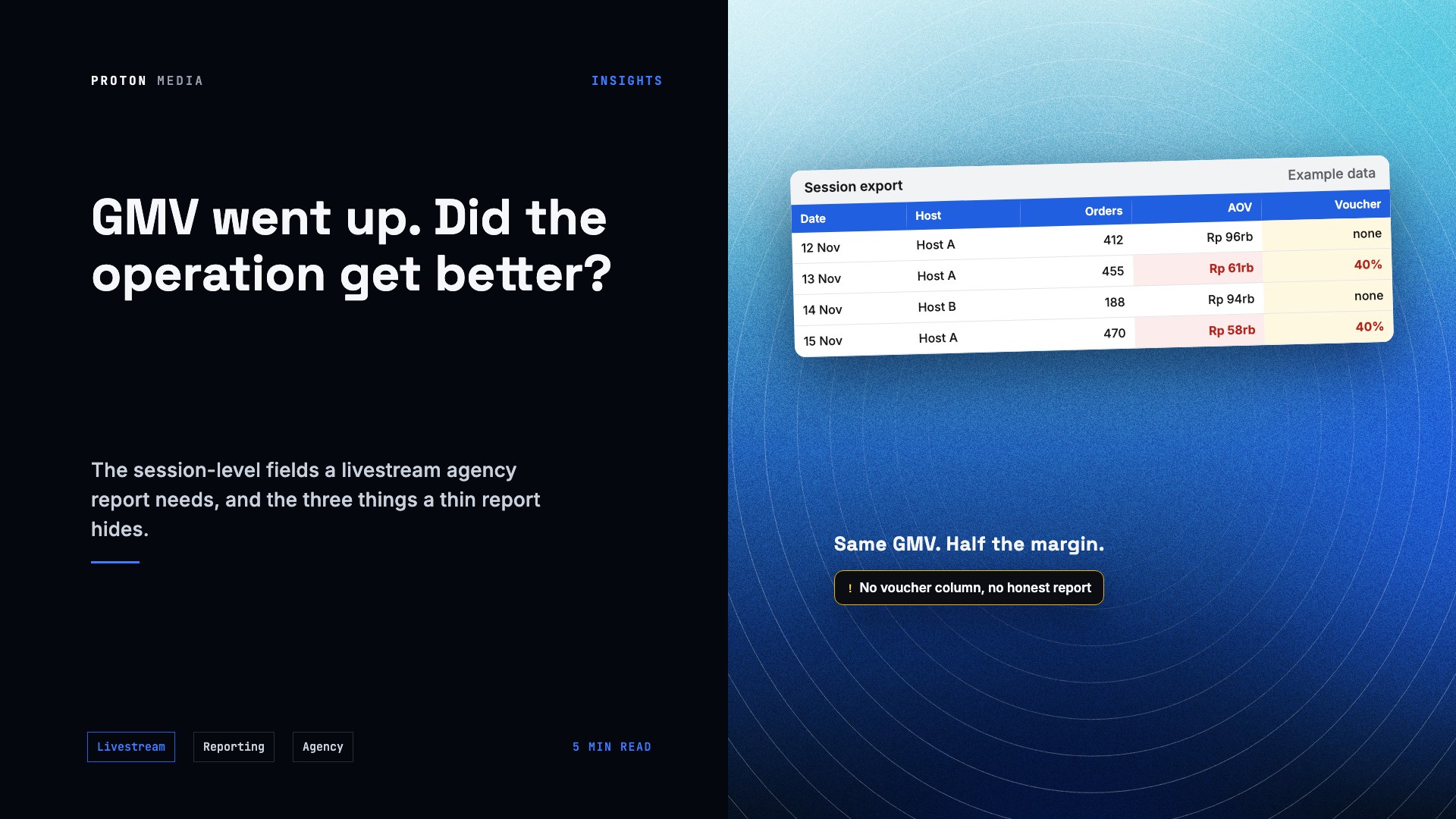
Most livestream agency reports show two numbers prominently: GMV and total viewers. Both can rise while your business gets worse.
GMV rises when you discount harder. Viewers rise when the agency buys traffic or streams at peak hours against weak competition. Neither number tells you whether the operation is getting better at selling. If your monthly report leads with those two figures and little else, you are looking at a marketing document, not an operations report.
Here is what we think a brand should require instead, and why each field exists.
Ask for session rows, not monthly totals
A monthly aggregate hides the only thing worth knowing: which sessions worked and which did not.
One strong twin-date session can carry a whole month of mediocre streams. The monthly average looks fine. You repeat the schedule next month, and the result is worse, because the thing that worked was the date, not the schedule.
Require one row per session. Thirty rows for thirty streams.
The fields that make a report readable
| Field | Why it matters |
|---|---|
| Date, start time, duration | Lets you compare slots instead of guessing at them |
| Host | Performance varies by host more than most brands expect |
| Products featured, in order | Tells you what the host actually pushed, not what was in the cart |
| Product clicks | The leading indicator you can influence during the stream |
| Orders | Already contains traffic, click-through and checkout, compressed into one number |
| GMV and average order value | GMV alone cannot tell you whether you discounted your way there |
| Voucher or promo running | Without this, every other number is uninterpretable |
The last row is the one agencies most often leave out, and it is the one that makes the rest honest. A session with a 40% voucher and a session at full price are not comparable, and a report that does not say which was which is not reporting.
We wrote separately about which livestream metrics actually move GMV, including why order velocity is the signal to watch during a stream rather than viewer count. The reporting standard here follows from that: if orders and product clicks are what matter, they belong in every row.
Three things a thin report hides
Discount dependency. If GMV holds steady but average order value falls every month, the operation is buying its results. You will find this only by putting AOV next to the voucher column.
Host concentration. If one host produces most of the revenue, you have a staffing risk, not a system. That host leaves and your channel drops. A report without a host column will never show you this.
Dead hours inside live hours. Six hours of streaming is not six productive hours. Order timestamps show where the selling actually happened. Brands paying for six-hour days are often paying for two.
What to ask for in month one
Do not wait for a quarterly review to find out the reporting is thin. Ask in the first month, while the relationship is easy to adjust:
- A session-level export, in a spreadsheet you can filter yourself. Not a slide deck, not a PDF.
- The raw numbers behind any chart. If a chart cannot be traced to rows, treat it as an opinion.
- A written note on what changed and why, per month. Which products were rotated out, which slots were dropped, what the next test is.
Point three matters more than it looks. An agency that cannot say what it changed is not running an operation. It is streaming on a schedule and reporting the weather.
The standard cuts both ways
Reporting like this is more work for the agency, and it exposes bad months plainly. That is the point. It also protects the agency, because a session-level record is the only way to show that a flat month was a product or pricing problem rather than an execution one.
We include session-level reporting on our managed livestream packages for that reason, and we would rather argue about a real row than defend a monthly average.
If you are reviewing an agency now, ask for one month of anonymised session rows from an existing client before you sign. How quickly that arrives, and in what format, tells you most of what you need to know.