The Uncomfortable Truth About Manual Campaigns
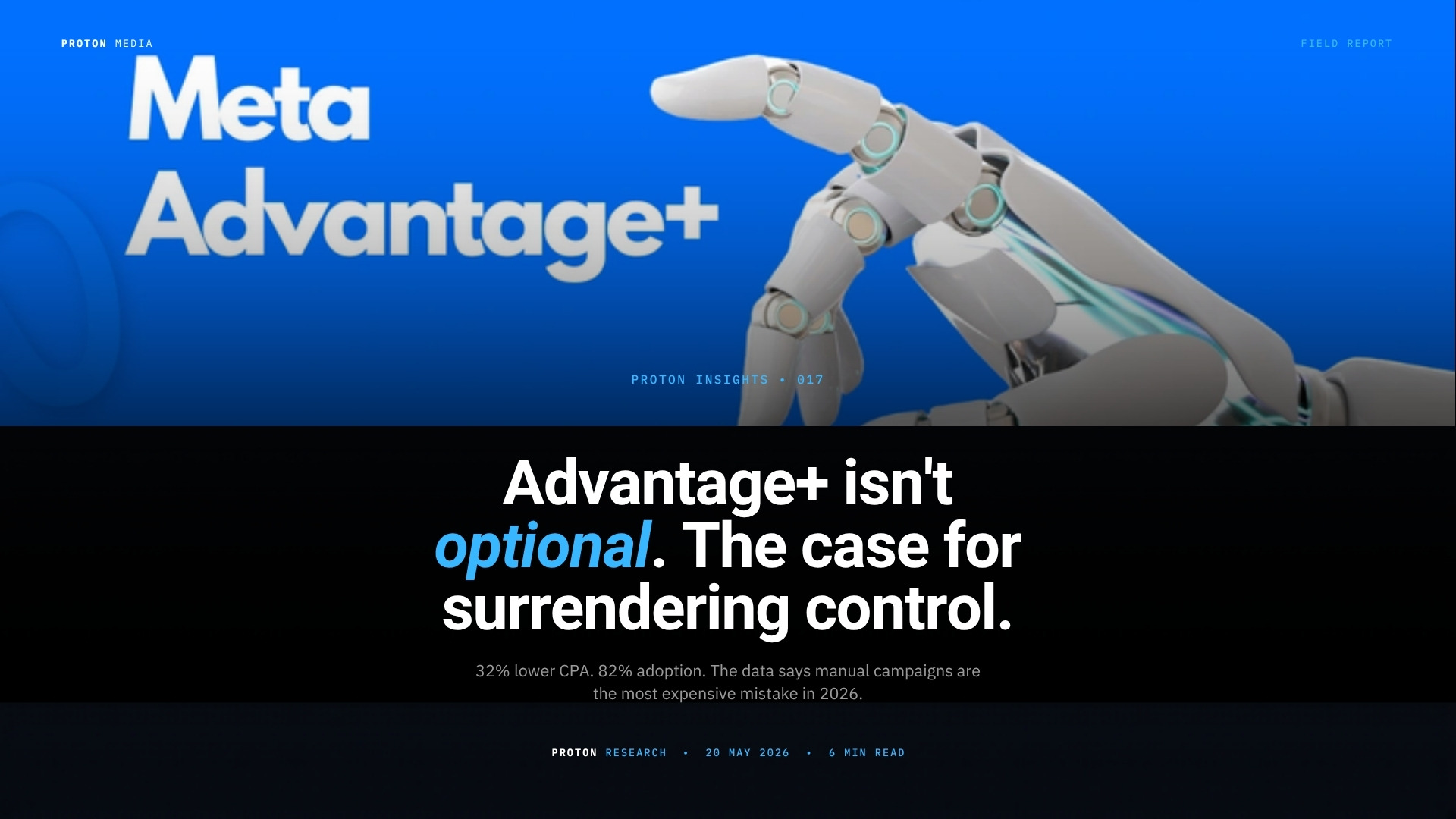
Let’s start with the numbers that should end every internal debate about campaign structure: Meta says existing Advantage+ Shopping Campaign users report a 17% decrease in cost per action and a 32% increase in return on ad spend.
That’s not a rounding error. That’s roughly a sixth of your acquisition cost, gone, because you let the algorithm do what it was designed to do. These are Meta’s own figures, reported by advertisers already on the product, so read them as a direction, not a guarantee for your account.
This isn’t early-adopter territory anymore. The holdouts aren’t making a strategic choice. They’re making an expensive one.
And since February 2026, according to AdMove’s 2026 Advantage+ creative guide, all new Sales, Leads, and App Promotion campaigns launch with every Advantage+ creative enhancement turned on by default. You have to actively opt out. The platform isn’t suggesting automation anymore. It’s assuming it.
This isn’t a beta feature. This is the platform telling you the algorithm is better at your job than you are. The question isn’t whether to adopt — it’s how much performance you’re leaving on the table by resisting.
Why the Old Structures Backfire Under Andromeda
The playbook that worked in 2023 — twelve ad sets, each with a different interest stack, each with its own budget — is now actively working against you.
Here’s the math. Meta says an ad set usually exits the learning phase after about 50 results in the week after its last significant edit. If you’re spending $500/day across 12 ad sets, that’s roughly $42 per ad set per day. At a $15 CPA, each ad set generates about 2.8 conversions daily — 19.6 per week. None of them exit learning. Ever.
You’re not optimizing. You’re fragmenting your budget into twelve tiny pools, each too shallow for the algorithm to learn anything useful.
It gets worse under Andromeda. Practitioners who have studied the rollout, such as Confect, report that the system will override your targeting when creative signals suggest a better match elsewhere. You can spend hours building an audience architecture the system treats as a suggestion. Your structure isn’t a strategy — it’s overhead.
| Problem | What Happens | Result |
|---|---|---|
| Budget fragmentation | 12 ad sets × $42/day each | None exit learning phase |
| Narrow audiences | Algorithm overrides targeting | Your structure is ignored |
| Competing ad sets | Internal auction overlap | You bid against yourself |
| Manual placements | Miss cheaper inventory | Higher CPM than necessary |
The 2026 Campaign Structure That Actually Wins
Here’s the structure we recommend as a starting point (a planning split, not a measured benchmark):
60–70% of budget → Advantage+ Shopping Campaigns (ASC)
This is your primary scaling engine. It consolidates audience discovery, placement optimization, and creative rotation into a single campaign that learns faster because it has the budget depth to do so.
20–25% → Broad targeting with 1–2 ad sets
Your creative testing sandbox. No interest targeting, no lookalikes — just broad with differentiated creative. This is where you test new angles, hooks, and formats before promoting winners into ASC.
10–15% → Retargeting (30-day window)
Warm audiences only. Website visitors, video viewers, engaged profiles. Keep this lean — ASC already captures most of your retargeting opportunity through its built-in prospecting/retargeting blend.
One more reason to let ASC handle placements: it can shift budget into Reels and other placements automatically, while manual placement selection can miss cheaper inventory.
Creative enhancements, audience matching and placement optimization all run inside the same system. The compounding effect of full automation is what makes ASC dominant.
Signal Quality: The One Thing You Still MUST Control
Surrendering campaign structure to the algorithm doesn’t mean surrendering everything. There’s one area where your input is irreplaceable: signal quality.
Pixel + Conversions API simultaneously. Browser-only tracking is dead. iOS privacy changes, ad blockers, and cookie restrictions mean a pixel-only setup misses part of your conversions. CAPI fills the gap — but you need deduplication to avoid double-counting. Both firing, deduplicated, is the baseline.
One prioritized conversion event. Pick your primary conversion — purchase, lead, signup — and commit to it. Switching conversion events mid-campaign resets the algorithm’s learning. Every reset sends the ad set back into learning, and Meta notes that ad sets in the learning phase usually have a higher CPA.
Attribution window matched to purchase cycle. A 7-day click window works for impulse purchases. A 30-day view-through might be right for high-consideration products. Match the window to your actual customer journey — not to whatever makes your dashboard look best.
Clean signal equals faster Andromeda learning, which equals lower effective CPMs. This is the one lever where human judgment still matters more than automation.
The Mindset Shift for Performance Teams
The hardest part of this transition isn’t technical. It’s psychological.
Performance marketers built careers on audience architecture — finding the perfect lookalike stack, the niche interest combination that unlocks cheap conversions. That skill had real value when the algorithm was dumb. Andromeda isn’t dumb anymore.
Stop asking “how do I control the algorithm?” Start asking “how do I feed the algorithm better inputs?”
Your competitive edge in 2026 is no longer audience architecture. It’s three things:
- Creative velocity. More creative variants, tested faster, with systematic learning loops. The algorithm needs creative diversity to find winners — give it options.
- Signal quality. Clean conversion data, properly attributed, consistently measured. This is the raw material the algorithm optimizes against.
- Campaign simplicity. Fewer campaigns, fewer ad sets, larger budget pools. Give the algorithm room to learn instead of constraining it into narrow boxes.
The agencies winning right now are creative studios with media buying skills — not the other way around. The buying part is increasingly automated. The creative part is increasingly the differentiator.
The platform’s incentive is clear: make automation work so well that manual control becomes irrational. Meanwhile, Meta reported that average price per ad rose 12% year-over-year in Q1 2026. The cost of NOT adapting is compounding.
The algorithm isn’t your enemy — your resistance to it is. We build performance marketing strategies designed for how Meta actually works in 2026, not how it worked in 2023. Let’s restructure your campaigns.