Every TikTok Shop seller knows the feeling: thousands of views, barely any orders. The video hits the FYP, the view count climbs, and then... nothing. No clicks. No carts. No revenue.
The problem isn't traffic. It's the funnel — or more accurately, the lack of one.
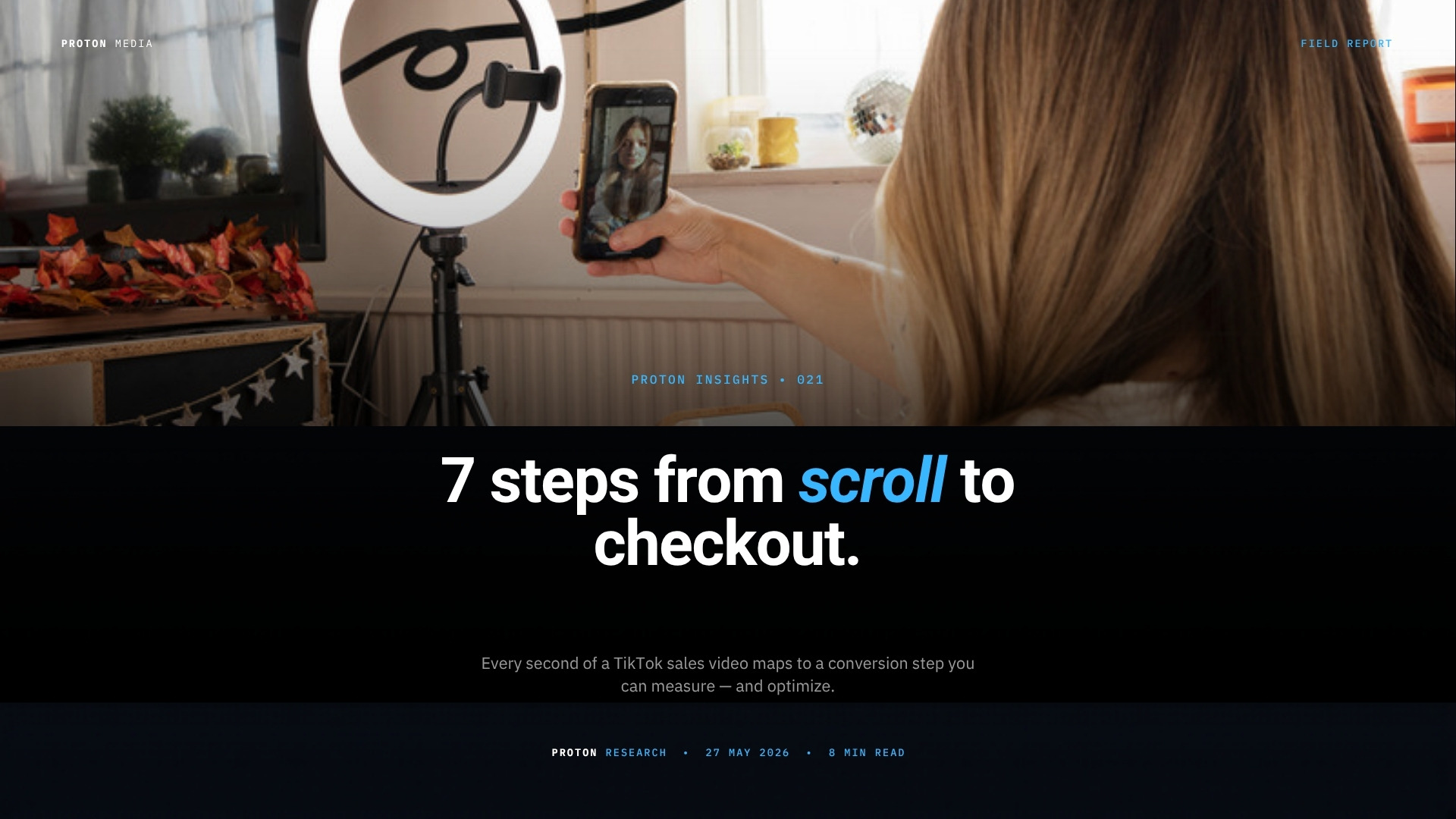
Most creators treat short video as a content format. The sellers actually making money treat it as a 7-step conversion pipeline, where every second of footage maps to a specific metric they can measure and optimize. Miss one step, the whole chain breaks. Nail all seven, and you turn 30 seconds of video into a repeatable sales engine.
Here's the framework.
The 7-step short video sales funnel
The user journey from scroll to order isn't random. It follows a predictable sequence, and each step has a conversion metric attached to it:
1. Scrolling (user is on FYP) → 2. Hook (stop or keep scrolling) → 3. Finish Rate (watch to the end) → 4. Engagement (like, comment, share) → 5. CTR (click the yellow cart) → 6. Click to Order (add to cart, checkout) → 7. Order Completed (payment, AOV)
The insight that changes everything: each step is independently measurable. If your CTR is strong but Click to Order is weak, the problem isn't your video — it's your product page. If views are high but Hook Rate is low, your opening 3 seconds need surgery. You stop guessing and start diagnosing.
Steps 1-2: Capture — the 3-second verdict
Your video lives or dies in the first 3-10 seconds. That's the hook window. Outside of it, they've already scrolled past.
Three hook strategies that consistently stop thumbs:
Personal branding. If your face is recognizable, your face is the hook. Consistent appearance creates instant recognition — viewers stop because they already know you deliver value. That recognition is an edge a faceless product account has to work much harder to earn.
Provocative opening. Skip the pleasantries. No "hey guys, today I want to share..." — that's 4 seconds of nothing. Lead with a statement that creates curiosity or mild disbelief. The opening line should be the punchline, not the setup.
Visual hook. Text overlay in the first frame. A shocking statistic. A dramatic before/after. Anything that makes the brain pause and process before the thumb can scroll.
Once you've stopped the scroll, the next challenge is keeping them. Finish Rate measures what percentage of viewers watch to the end. Three tactics drive it up:
Change your camera angle every 3 seconds. Close-up to side angle to overhead to text overlay — visual variety keeps the brain engaged. Korean drama editors figured this out years ago: constant visual change = sustained attention.
Tutorial and demo content naturally has high finish rates. When viewers feel they'll miss something useful by leaving, they stay. Show the product in action, not just on display.
Build curiosity early, deliver the payoff late. Promise something at second 3, reveal it at second 25. Viewers stay because the open loop bothers them.
A good starting length for video duration? 15-30 seconds. Shorter than 15 and it's hard to build enough value. Longer than 30 and every extra second has to earn its place, because viewers leave when a video drags. And never let more than 2 seconds pass without a visual change or new piece of information.
Steps 3-4: Intent — turning viewers into buyers-in-waiting
Engagement Rate — likes, comments, and shares divided by total views — is the signal TikTok's algorithm uses to decide whether your video deserves more distribution. Higher engagement means more reach. More reach means more potential buyers entering your funnel.
The most reliable engagement hack isn't being entertaining. It's being controversial or comparative. "Which one is better: Product A or Product B?" generates hundreds of comments from people picking sides. One comparison video can outperform ten standard product showcases on engagement alone.
Asking direct questions works too. "Which color would you pick?" or "Have you tried this?" converts passive viewers into active commenters. The algorithm treats comments as high-value signals — each one expands your reach.
Then comes the step most sellers fumble: CTR — getting viewers to click the yellow cart icon. This is where content becomes commerce, and it requires a deliberate call to action.
Three CTA patterns that drive clicks:
Direct command. "Click the yellow cart below — grab it now." Don't assume viewers know what to do. Tell them. CTA isn't optional in selling videos; it's mandatory.
Price trigger. Mention the price explicitly. Even if they don't buy, curiosity about the number drives clicks. "Only 300K — check it out" works because the specific number creates a reference point that demands verification.
Urgency and scarcity. "Only 5 left in stock" or "Flash sale ends tonight." FOMO remains one of the strongest conversion drivers in social commerce. The fear of missing out bypasses rational comparison shopping.
Steps 5-6: Close — where the money actually happens
Click to Order Rate measures how many people who clicked the yellow cart actually proceed to checkout. This is where most funnels leak, and the fixes are often outside the video itself.
Four common drop-off killers:
Bad seller reviews. A weak seller rating gives buyers a reason to back out on the product page before checkout. Curate your yellow cart ruthlessly. A sensible rule of thumb: only add products from sellers rated 4.5 or higher with at least 50 reviews.
Price mismatch. If your video implies "cheap" but the product page shows 500K, visitors bounce. Transparent pricing in the video eliminates sticker shock at checkout.
Abandoned carts. People add to cart, get distracted, forget to pay. A simple reminder in the video — "Don't forget to check out after adding to cart!" — can win back some of these lost sales.
Too many variants. 50 options in the cart creates decision paralysis. Highlight 1-2 specific variants in your video so viewers know exactly what to pick.
Finally, Average Order Value (AOV) determines how much revenue each completed order generates. Four strategies push it higher:
Bundle products. "Buy 2, save per unit" increases ticket size without increasing customer count. Upsell premium variants after commitment — "the original is only 50K more" feels small after they've already decided to buy. Set a free shipping threshold just above your average price point to encourage adding one more item. And follow up after purchase for repeat orders — returning customers consistently spend more.
The ultimate north star metric tying everything together: GPM (GMV per Mille) = GMV per thousand views, as TikTok Shop's seller guide defines it. When GPM rises, it means your entire funnel is working. What counts as a good GPM depends on your category and price point, so track your own trend rather than a universal target.
The 30-second script template
Every second in a TikTok sales video should have a purpose. Here's the framework for a 30-second selling video:
0-3s — HOOK. Provocative statement, face close-up, or text overlay that stops the scroll.
3-10s — VALUE. Product demo, before/after, or educational content. Prove the video is worth watching.
10-30s — RETAIN. Change angles every 3 seconds. Close-up to side to overhead to text overlay. Keep the visual rhythm alive.
±15s — ENGAGE. Drop a comparison or controversial take. "Which version do you prefer?" — bait for comments.
±20s — CTA CART. Direct instruction to click the yellow cart. Mention price or deal.
±25s — URGENCY. Limited stock, flash sale ending, time-sensitive offer.
±30s — REMINDER. "Don't forget to complete your payment!" — simple cart recovery.
Hook at second 3, CTA at second 20, closing at second 30. No dead air. No wasted frames.
The scorecard that tells you what's broken
Track these weekly per video. Set each target from your own recent videos, not from someone else's benchmark. When a metric falls below your own baseline, that's your optimization priority for the next content cycle:
Hook Rate: viewers watching past 3 seconds
Finish Rate: viewers watching to the end
Engagement Rate: likes + comments + shares ÷ views
CTR: yellow cart clicks ÷ views
Click to Order: checkouts ÷ cart clicks
AOV: trending upward
GPM: trending upward
The weekly review process: export your analytics from TikTok Creator Tools, identify the lowest-performing step across your videos, form a hypothesis ("CTR is weak — try adding explicit CTA with price"), test the fix across 3 videos, compare results, document what worked. One variable per test cycle. Compound improvement over time.
The bottom line
TikTok short video selling isn't about going viral. It's about building a measurable funnel where every second of content maps to a conversion step you can track and optimize. The sellers making consistent revenue aren't luckier — they're more systematic.
Start with 3 videos using the 30-second script template. Track every metric from hook rate to GPM. Find the weakest step. Fix it. Repeat weekly. That's the entire playbook.