You Just Burned Rp 5 Million. Here’s Where It Went.
You launched a Meta campaign last Monday. Budget: Rp 5 million. Objective: WhatsApp conversations. Result: 3 chats. One was a wrong number.
Sound familiar?
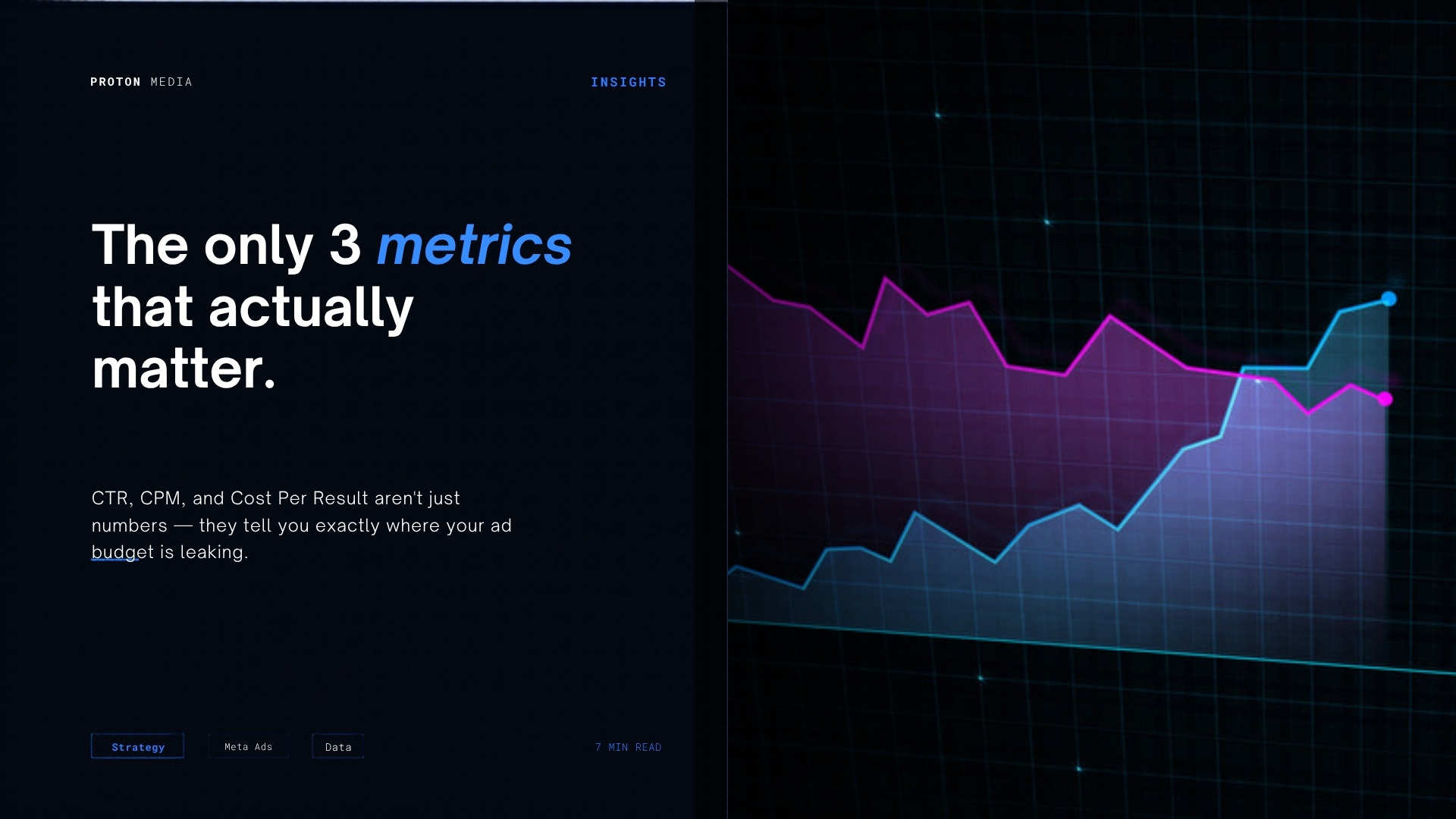
The instinct is to blame the algorithm, the audience, or the creative. But the real answer is almost always hiding in three numbers you probably glanced at and scrolled past: CTR, CPM, and Cost Per Result. These aren’t vanity metrics. They’re a diagnostic system. Each one tells you something different about where your money is going, and which lever to pull first.
By the end of this post, you’ll know how to read all three, which benchmarks are worth using (and their limits), and how to build a 4-week optimization loop around them.
What Is CTR (Click-Through Rate)?
Formula: (Link clicks ÷ Impressions) × 100
Meta defines link CTR as the percentage of impressions that received a link click. It measures one thing: how compelling your ad is to the people seeing it. A high CTR means your creative stopped the scroll. A low CTR means people saw your ad and kept moving.
2025–2026 benchmarks worth knowing:
| Source | CTR | What the data covers |
|---|---|---|
| WordStream 2025 | 1.71% (traffic campaigns), 2.59% (lead campaigns) | All-industry averages, US campaigns |
| LocaliQ 2026 | 1.93% (traffic), 2.70% (leads) | All-industry averages, latest edition |
| Triple Whale, full-year 2025 | 2.19% median, up 13.5% year over year | Nearly 35,000 ecommerce brands |
Travel is not a low-CTR category. It sits above average: 2.76% in WordStream’s 2025 traffic data and 2.28% in LocaliQ’s 2026 data.
The catch: all of these are US or ecommerce datasets. We haven’t found a public Indonesian CTR benchmark solid enough to quote, so treat them as a rough frame and compare against your own account history first. On our in-house umrah brand, Faaza Travel, click-to-WhatsApp CTR went from 0.78% in July 2026 to 0.99% in September 2026. That’s below every US benchmark above, and cost per lead still fell 22%. CTR never tells the whole story on its own.
Meta Ads CTR by campaign objective
Your campaign objective changes what a “good” CTR looks like, because it changes who Meta shows the ad to. In Meta’s words, the performance goal is “the specific outcome that Ads Manager optimizes your ad delivery for.”
| Objective | What Meta optimizes for | CTR to expect |
|---|---|---|
| Awareness | Reaching “the largest number of people who are most likely to remember your ad” | Clicks aren’t the goal. Judge it on reach and ad recall, not CTR. We haven’t found a public awareness CTR benchmark we trust. |
| Traffic | Sending people to a destination, like a website or shop | 1.71% (WordStream 2025), 1.93% (LocaliQ 2026) |
| Leads | Collecting leads via messages, calls or sign-ups | 2.59% (WordStream 2025), 2.70% (LocaliQ 2026) |
| Sales / messages | People likely to buy or start a conversation | Judge on cost per result. Our click-to-WhatsApp example above ran at 0.99%. |
The practical rule: only compare CTR between campaigns with the same objective. An awareness campaign with a 0.5% CTR and a lead campaign with a 2.5% CTR can both be doing their job. (Meta’s objective guide)
Why CTR matters beyond clicks: in Meta’s auction, the winner is the ad with the highest total value: a mix of your bid, how likely people are to take the action you want, and ad quality. Because relevance is part of that, Meta says an ad that’s more relevant to a person can win an auction against ads with higher bids. Better creative doesn’t just earn clicks. It helps you compete without raising your bid.
How to optimize CTR:
- Hook in the first 3 seconds. For video, that means the pattern interrupt happens before the thumb lifts. For static images, use headlines that create an open loop or contradict expectations.
- Test several creatives, one variable at a time. One winner isn’t a strategy. Meta’s own A/B testing guidance says tests are more conclusive when versions are identical except for the variable being tested, and recommends running them for at least 7 days.
- Test Advantage+ creative against your own version. Let Meta’s automated enhancements compete with your manual edit, and keep whichever wins on cost per result in your account.
- Watch the relevance diagnostics. Check quality ranking in Ads Manager next to CTR, so a weak ad shows up before it drains the budget.
What Is CPM (Cost Per Mille)?
Formula: (Amount spent ÷ Impressions) × 1,000
CPM is the average cost of 1,000 impressions. It tells you how expensive your audience is to reach, and it’s driven far more by auction competition than by how good your ad is.
2025–2026 benchmarks:
- Triple Whale: median CPM of $14.19 in 2025, up 20.03% year over year.
- Lebesgue 2026: CPM ranges from about $6.96 to $12.46 depending on the industry.
- Most expensive industries: Beauty and Health in Lebesgue’s data ($12.46), Health & Wellness in Triple Whale’s (a $20.70 median in 2025).
These come from different datasets, so don’t blend them into one “global average”. Pick the one closest to your business.
What about Indonesia? Every dataset we checked puts Indonesian CPMs far below the US, but none gives a figure solid enough to publish. For a real local reference: Faaza Travel’s campaign CPM reached Rp 165K in August 2026.
Do higher CPMs mean higher-quality traffic?
No. CPM is the price of winning impressions, not a quality score. Meta’s auction picks the ad with the highest total value (your bid, how likely people are to act, and ad quality), so a high CPM mostly tells you the audience is crowded, narrow, or that it’s peak season. It says nothing about whether those people will buy. Judge traffic quality after the click: conversion rate and cost per result.
Why CPM rises:
- More advertisers chase the same people. When dozens of brands all target “women 25–34 interested in skincare in Jakarta”, the price goes up.
- Q4 is peak season. In Superads’ US data, CPMs climb into Q4, peak in November ($27.47 in November 2025), and ease in December.
- Over-narrow audiences shrink the pool you’re bidding for.
How to optimize CPM:
- Broaden your targeting. Use Advantage+ Audience with looser constraints, and give Meta room to find cheaper impressions among people who convert.
- Check for audience overlap. If two of your ad sets chase the same people, you’re bidding against yourself.
- Improve relevance, not just bids. Since relevance is part of the auction’s total value, a stronger creative is often a cheaper fix than a higher bid.
- Plan around Q4. Lock in learnings and winning creatives before November, when the auction is most crowded.
What Is Cost Per Result?
Formula: Amount spent ÷ Number of results
Meta defines it as the average cost per result from your ads. “Result” depends on your campaign objective: a conversation started for a messaging campaign, a lead for lead gen, a purchase for ecommerce. It’s the metric closest to ROI.
Meta lists what moves it: your bid, target audience, optimization type, ad creative and messaging, and schedule.
A real example (our own brand): Faaza Travel’s WhatsApp cost per lead went from Rp 59K in July 2026 to Rp 46K in September 2026 after we rebuilt the campaign structure and creative. Faaza is Proton Media’s in-house umrah brand, and we wrote up how we ran that loop.
How to optimize Cost Per Result:
- Choose the right bid strategy. Bid Cap gives you cost control at the expense of volume. Cost Cap optimizes for efficiency while letting Meta flex. Lowest Cost maximizes volume but gives you no ceiling. Start with Cost Cap, then test Bid Cap once you know your target cost per result.
- Relevant creative beats beautiful creative. The ad that speaks directly to a pain point will usually outperform the one with better production value but generic messaging.
- Build Lookalike Audiences from buyers, not from all engagers. A like is cheap. A purchase is signal. Seed your lookalikes with the highest-intent action available.
- Run a retargeting layer. In Lebesgue’s 2024 data, retargeting ads converted at 2.86% versus 0.99% for prospecting, even though their CPM was slightly higher ($8.43 vs $7.50). You pay a bit more per impression and win it back on conversion.
How These 3 Metrics Are Connected
Think of it as a funnel: CPM → CTR → Cost Per Result.
CPM determines how much it costs to show your ad. CTR determines how many of those impressions become clicks. And your conversion rate after the click determines your Cost Per Result.
Here’s the formula that ties them together:
Cost Per Result = CPM ÷ (1,000 × CTR) ÷ CVR
Let’s walk through an example: - CPM: $10 (you pay $10 per 1,000 impressions) - CTR: 2% (20 clicks per 1,000 impressions) - CVR: 5% (1 conversion per 20 clicks) - Cost Per Result = $10 ÷ (1,000 × 0.02) ÷ 0.05 = $0.50 per click ÷ 0.05 = $10
Now change one variable. Drop CTR to 1%: - Cost Per Result = $10 ÷ (1,000 × 0.01) ÷ 0.05 = $1 per click ÷ 0.05 = $20
Halving CTR doubled your cost per result. That’s why creative testing isn’t optional. It’s the highest-leverage activity in your ad account.
The four scenarios:
| CPM | CTR | Result |
|---|---|---|
| High | Low | Money on fire. Kill the campaign. |
| High | High | Potentially profitable. Audience is expensive but engaged. |
| Low | Low | Cheap reach, bad creative. Fix the ad. |
| Low | High | The sweet spot. Scale this. |
“High” and “low” here mean against your own account average, not against a US benchmark.
The 4-Week Optimization Framework
Stop optimizing randomly. Use this cycle:
Week 1: Baseline. Record CTR, CPM, and Cost Per Result for every active campaign and ad set. You can’t improve what you haven’t measured. Export the data. Put it in a spreadsheet. This is your starting point.
Week 2: Cut the dead weight. Pause creatives whose CTR sits well below your account average once they’ve had enough impressions to judge. Don’t be sentimental about ads that took hours to produce. If the audience doesn’t care, the audience doesn’t care.
Week 3: Reallocate. Shift budget from underperforming ad sets to the ones with the lowest Cost Per Result. This isn’t about impressions or reach. It’s about efficiency. Double down on what’s working.
Week 4: Test bid strategies. Run a proper A/B test: Cost Cap against Lowest Cost on the same audience and creative, for at least 7 days. What works for one vertical often doesn’t work for another.
Ongoing: Rotate creatives before they wear out. Creative fatigue kills CTR quietly: your CPM stays flat, your CTR drops, and your Cost Per Result creeps up before you notice.
The Bottom Line
Three questions. Three metrics.
- CTR answers: “Is my ad interesting?”
- CPM answers: “Is my audience expensive?”
- Cost Per Result answers: “Is any of this actually profitable?”
Don’t try to optimize all three simultaneously. Find the worst one, fix it, then move to the next. If CTR is far below your account average, no amount of audience work will save you. If CPM is through the roof, broadening your targeting will do more than tweaking your headline.
The advertisers who win on Meta aren’t the ones with the biggest budgets. They’re the ones who read these three numbers every morning and make one decision before lunch.
Updated 24 October 2026: benchmarks re-checked against their sources; figures we couldn’t verify were removed.