The Adoption Paradox: Everyone’s Talking, Few Are Walking
You’ve heard it fifty times this quarter. “We need an AI strategy.” Your CMO mentioned it at the last all-hands. Your CEO shared a LinkedIn post about it. Someone on the team signed up for ChatGPT Plus and started writing ad copy with it.
And then nothing changed.
That gap — between knowing AI matters and actually making it work — is where most marketing teams are stuck right now. The data says the cost of staying stuck is compounding every month.
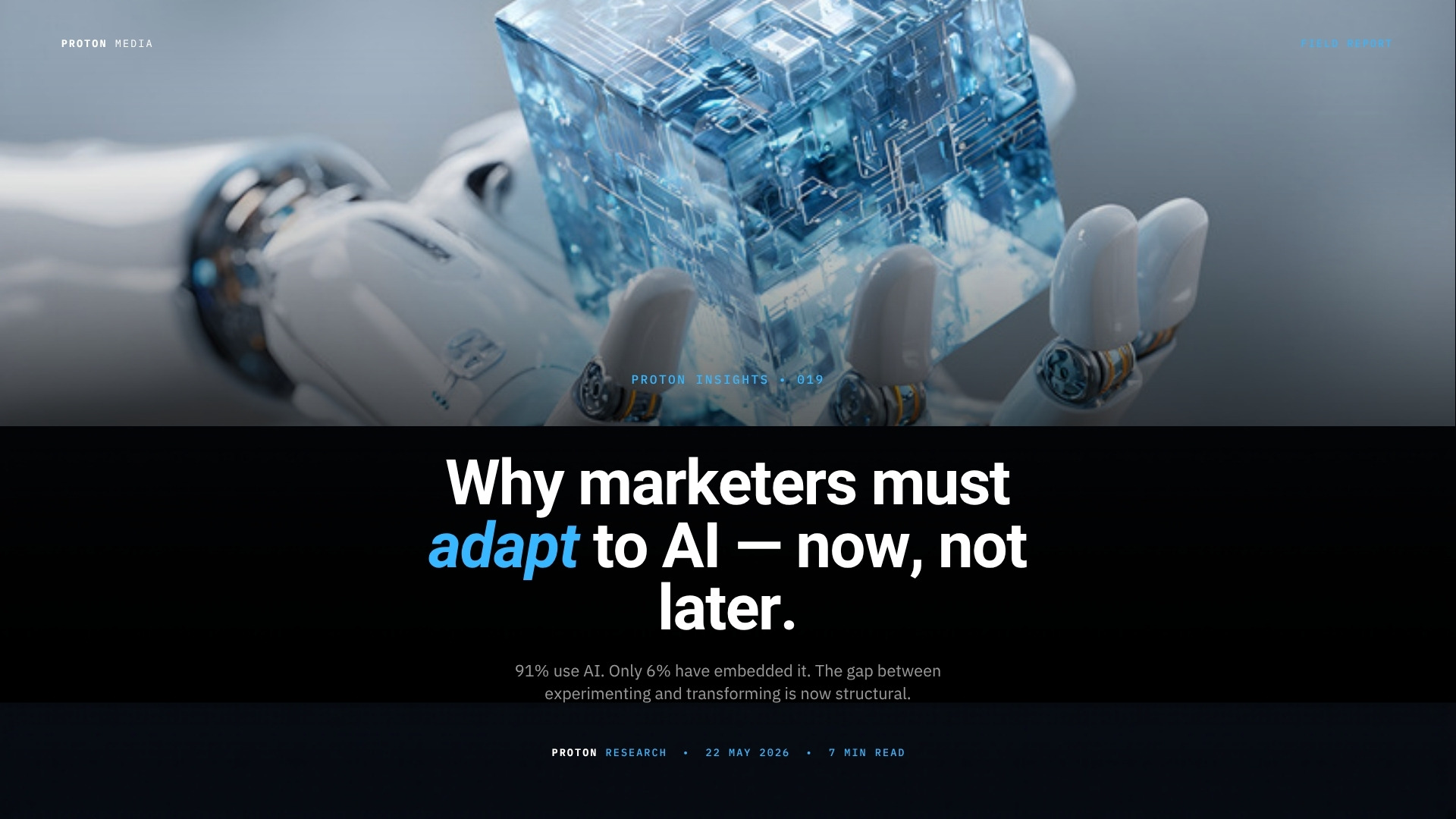
91% of marketers now use AI in some capacity, according to Jasper’s State of AI in Marketing 2026 report. That sounds like near-universal adoption. It’s not.
Only 6% have fully embedded AI into their workflows. That stat comes from Supermetrics’ 2026 Marketing Data Report, surveying 435 global marketers. Six percent. Meanwhile, 80% feel pressure to adopt AI, and 89% of them say that pressure comes from the C-suite and board, yet 37% say leadership hasn’t given them a clear AI strategy.
Adoption is not integration. Most teams are experimenting — trying a tool here, automating a caption there. That’s not transformation. That’s tourism. And tourism doesn’t compound.
The ROI Is Real — And the Gap Is Widening
The business case for AI in marketing stopped being theoretical about two years ago. Now it’s measurable, repeatable, and increasingly well-documented.
Company-wide, the returns are measurable. IDC’s study for Microsoft found that for every $1 a company invests in generative AI, the average return is 3.7x, across all business functions, not marketing alone. Marketing-specific ROI figures are thinner and vary widely by source, which is one more reason to measure your own.
The problem isn’t that AI doesn’t work. It’s that the teams who’ve figured it out are compounding their returns while everyone else is still comparing feature lists. The gap between AI-mature and AI-curious teams isn’t closing. It’s becoming structural. And structural gaps don’t close with a tool subscription — they close with organizational commitment.
Where AI Is Actually Being Used (And Where It’s Wasted)
This is where it gets uncomfortable.
In the same Supermetrics report, 87% of marketers use AI for content creation and copywriting. Makes sense. It’s the path of least resistance: write a brief, get a draft, edit it, publish. Low risk, visible output, fast payoff.
But only 39% use AI for reporting and analytics. Only 33% for marketing automation.
Fewer than four in ten are using AI where their measurement problems actually sit.
Content generation is table stakes. Every competitor can produce more content faster now. The competitive advantage has shifted to analytics, personalization, and decision intelligence — areas where AI processes signals at a scale and speed that human teams cannot match. The question isn’t whether you’re using AI. It’s whether you’re using it where it actually creates separation.
The Personalization Imperative
Consumers don’t care about your AI strategy. They care about relevance.
AI is what makes personalization possible at speed: tailoring messages, offers, and timing to individual behavior instead of broad segments.
The takeaway isn’t that AI improves personalization. The takeaway is that personalization without AI is becoming structurally uncompetitive. When your competitor’s algorithm is tailoring messages, offers, and timing to individual behavior in real time, your quarterly persona refresh isn’t going to cut it.
Consumers don’t see “AI.” They see brands that get them and brands that don’t. If your brand isn’t personalizing at speed, someone else’s algorithm is already winning your customer’s next click.
The Data Foundation Problem
This is the part nobody wants to headline at AI conferences.
In Supermetrics’ 2026 survey, 52% of marketers don’t own their data strategy. Only 31% say the CMO is meaningfully involved. 40% struggle to prove ROI across channels. Only 33% say they can activate their data effectively.
You cannot AI your way out of bad data. Full stop.
The companies winning with AI aren’t the ones with the fanciest tools or the biggest model budgets. They’re the ones who fixed their data plumbing first. Clean data in, useful outputs out. Messy data in, faster mess out.
AI amplifies whatever foundation you’ve built. If that foundation is a collection of disconnected spreadsheets, inconsistent naming conventions, and siloed channel data, AI will just help you make mistakes at machine speed. That’s not a productivity gain. That’s an accelerated liability.
This Isn’t a Trend — It’s a Transition
Step back from the tactical for a moment and look at the structural shift happening beneath it.
88% of organizations now report regular AI use in at least one business function, up from 78% a year earlier, according to McKinsey’s State of AI 2025 survey.
The next shift is already on the table: AI agents that don’t just automate tasks but change how marketing functions are organized. Not automated. Restructured. That’s a different word with a different implication.
This isn’t about “should we adopt AI?” anymore. It’s about whether your team can close the gap before the gap becomes your permanent competitive disadvantage.
What Adaptation Actually Looks Like
Theory is cheap. Strategy decks are easy. Here’s what actually moves the needle:
Own your data strategy. If marketing doesn’t define how data is collected, cleaned, and structured, every AI use case stalls at the foundation. This isn’t IT’s job alone. Marketing needs a seat at the data architecture table — not as a stakeholder, but as a co-owner.
Move beyond content generation. Content is where everyone starts. Analytics, personalization, and workflow automation are where returns compound. If 90% of your AI budget goes to writing tools and 10% goes to intelligence tools, your allocation is inverted.
Build AI governance now. The risk doesn’t scale linearly with adoption — it scales exponentially. Establish guidelines for data usage, output review, brand voice compliance, and accountability before an incident forces you to.
Measure what matters before adding tools. 40% of marketers in Supermetrics’ survey struggle to prove ROI across channels today — without AI. If your measurement framework is broken, adding AI tools won’t fix it. It’ll just automate the confusion. Fix the metrics first.
Upskill deliberately. Tools without training equal wasted licenses, frustrated teams, and executives who conclude AI doesn’t work because nobody learned how to use it properly.
The Bottom Line
The data is unambiguous. AI in marketing works. The ROI is real and documented. Adoption is accelerating across every function and industry. And the gap between teams that have integrated AI into their operations and teams still “exploring” is becoming structural and permanent.
The question isn’t whether your team should adapt to AI. It’s whether you can afford the cost of adapting slowly.
The answer, increasingly clearly, is no.