The Fatigue Acceleration Nobody Measured
Creative fatigue is not new. What’s new is how fast it happens.
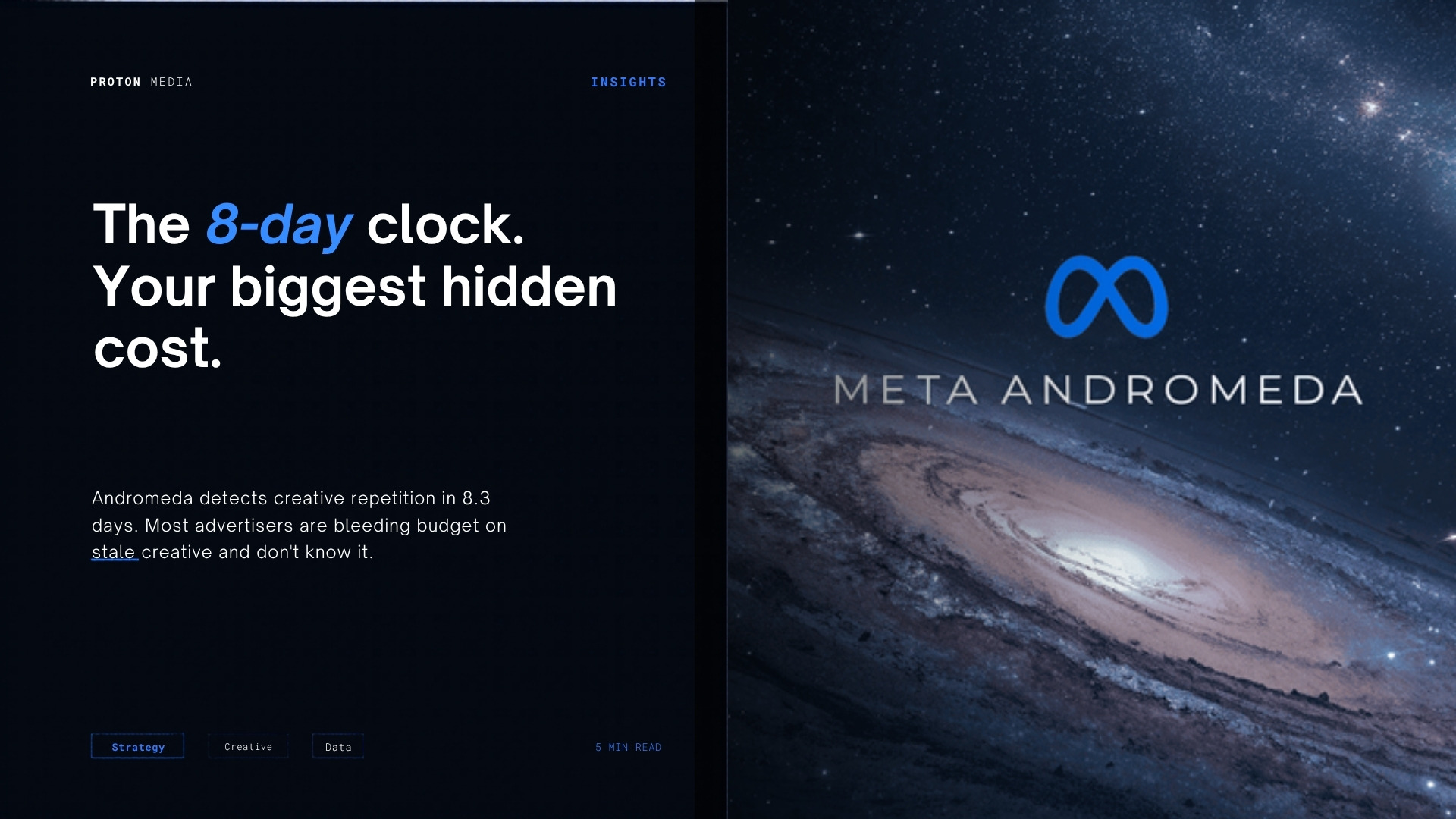
Pre-Andromeda, a strong static ad could run profitably for six or more weeks before performance degraded meaningfully. Post-Andromeda, the median effective lifespan for static creative has collapsed to 8.3 days. Video holds slightly longer at 11.7 days. These numbers come from a community-run test across 47 accounts on Reddit’s r/PPC, published May 2026 — one of the few datasets tracking fatigue velocity at scale.
The mechanism is straightforward. Andromeda’s retrieval system evaluates creative content at the vector level. When it detects that a user has seen semantically similar content multiple times, it deprioritizes that creative in retrieval. The ad doesn’t stop running — it stops being selected. Your budget continues spending, but on increasingly marginal impressions.
Your fatigued ad isn’t “performing worse.” It’s being quietly excluded from the best auction opportunities. The spend continues. The results don’t.
Why Andromeda Punishes Repetition Harder
The old ad delivery system was relatively blind to creative similarity. You could run 50 ads with minor variations — different headline, same image — and each would be treated as a distinct entry in the auction.
Andromeda doesn’t work that way. Its hierarchical indexing system clusters semantically similar creatives under a single Entity ID. If your Creative Similarity Score exceeds 60%, Andromeda treats your “different” ads as essentially one creative. Fifty ads competing for the same retrieval ticket.
This matters because Meta’s ecosystem now processes over 15 million AI-generated ads per month — the company confirmed that more than one million advertisers used its generative AI tools in 2025 alone. The retrieval queue is more competitive than ever. More ads in the system means fewer retrieval slots per creative, and zero tolerance for duplicates occupying multiple positions.
The advertisers who thrive run genuinely distinct creative. Scaledon’s data makes this visible: the top third of performers maintain 395 live ads versus 296 for the bottom third — a 33% volume gap. But volume alone isn’t the differentiator. It’s volume of distinct angles.
The Cost of Being Slow
Creative fatigue doesn’t show up as a line item. It shows up as rising costs with no clear cause.
CPC across Meta increased 11% year-over-year to $1.72 as of April 2026. Part of that is platform-wide inflation. But a meaningful portion is fatigued creatives losing retrieval priority, which inflates effective CPMs even when your bid stays flat. You’re not paying more because competition increased — you’re paying more because your creative stopped earning premium placement.
Confect quantified the broader impact: ROAS declined 7% across $834 million in tracked spend during Andromeda’s rollout period, with no recovery signal detected. For many advertisers, that decline wasn’t a dip — it was a permanent reset caused by creative strategies that couldn’t keep pace with the new retrieval dynamics.
Your best-performing ad is your biggest fatigue risk. It has the most impression density, which means it’s the first to trigger retrieval suppression.
A Realistic Creative Velocity Framework
The answer isn’t “make more ads.” It’s “make more different ads, on a cycle that respects the 8-day clock.”
Here’s the budget allocation that matches what we see working:
| Budget Share | Purpose | What It Looks Like |
|---|---|---|
| 50% | New concepts | Fundamentally different narratives, angles, visual styles |
| 30% | Refined variants | Proven performers with new hooks, cuts, or formats |
| 20% | Winners on watch | Keep running until CPMs rise without scale gains |
The production target: 8-12 conceptually distinct concepts per campaign, with 2-3 execution variants each, refreshed on a 2-3 week cycle. That’s not a guess — it’s the velocity benchmark from Segwise’s April 2026 analysis of top-performing Advantage+ campaigns.
“Conceptually distinct” is the operating phrase. A product demo shot in a kitchen and a product demo shot in a bathroom are not distinct. A product demo and a customer testimonial and a problem-solution narrative — those are distinct.
How to Operationalize Without Burning Your Team
The velocity requirement sounds brutal until you change what “creative” means.
Founder-led and authentic UGC delivers 2-3x ROAS over polished brand video, according to JetFuel’s portfolio data. This isn’t a budget-saving hack — it’s genuinely more effective because Andromeda reads authenticity signals in engagement patterns. A founder talking to camera on an iPhone generates different (and often better) engagement vectors than a studio shoot.
AI-generated creative shows 18% higher CTR versus human-designed alternatives in Digital Applied’s Q1 2026 analysis. Use AI for the volume layer — background variations, text overlay testing, format adaptation — while humans focus on the concept layer.
Advantage+ creative auto-enhancements deliver a 22% ROAS lift over manual creative according to Meta’s own testing via 1ClickReport. Let the system handle aspect ratio adjustments, brightness optimization, and placement adaptation. Your team should spend zero time on those.
The math works out: one strong concept, expressed as a founder video, an AI-adapted static variant, and an Advantage+-enhanced format adaptation, gives you three genuinely different retrieval entries from a single creative investment.
Creative velocity isn’t about production volume. It’s about concept velocity — the rate at which you introduce genuinely new narratives into the retrieval system. Three distinct angles beat thirty variations of one.
The 8-day clock is ticking on every creative you launch. The question isn’t whether your ads will fatigue — they will. The question is whether your production system can replace them before the budget starts bleeding. Build the system. Respect the clock.